
What if the most haunting part of a ghost tour isn’t a ghost, but the real history beneath the story? If you’ve wondered, “are ghost tours based on true stories,” the honest answer is: sometimes, and not always in the same way. A tour may combine documented events, local legends passed down over time, and personal reports of paranormal encounters. Those last two can be compelling, but they aren’t the same as proven historical fact.
It’s fair to want more than a chilling tale dressed up as history. Look for a storyteller to distinguish what records support, what tradition remembers, and what remains unexplained. That clarity lets you enjoy the atmosphere while treating the people and events behind each account with respect.
In this article, you’ll learn how to tell those story sources apart, how to interpret paranormal claims, and what to expect from a San Antonio tour. Sisters Grimm Ghost Tours brings historical insight, local lore, and spirited storytelling together on guided walking and bus tours. The past is real; the mystery is part of the adventure.
Key Takeaways
- When asking “are ghost tours based on true stories,” distinguish documented events from traditions passed down over time and reported paranormal experiences.
- Historical records can help establish who, what, and where, while oral accounts may shift as stories pass from one storyteller to another.
- A location’s documented history doesn’t prove a supernatural explanation. Notice what evidence supports each claim and what remains uncertain.
- Use a simple listening framework on a tour: identify the claim, consider its source, and stay curious about what can’t be verified.
- Sisters Grimm Ghost Tours connects San Antonio history and local lore through storytelling, guided by local owners Lauren and Angelique.
Are Ghost Tours Based on True Stories? The Short, Honest Answer
Sometimes, but “based on a true story” can mean several different things. A tour may draw on records documenting a person, place, or event; share a local legend retold over time; or include someone’s report of a strange experience. These sources can sit side by side in one tale, but they don’t carry the same weight. So, are ghost tours based on true stories? Often, they’re rooted in real places and history, while parts of the haunting remain lore or personal testimony.
That distinction matters. A building’s age, a documented tragedy, or a historical figure’s connection to a site can be checked against records. A claim that a spirit still appears there is a separate interpretation, not something established simply by the setting. A reported haunting is an account, not proof of a ghost. It may be meaningful to the person sharing it and still remain unverified.
What does “based on a true story” mean on a ghost tour?
Usually, a story begins with a historical anchor: a named person, place, or event supported by records. As the story passes from one teller to another, details may be added, sharpened, or remembered differently. Those embellishments can make a tale vivid, but they aren’t automatically confirmed by the original record. Keep the layers distinct: history establishes a setting, while the supernatural explanation is an interpretation attached to it.
For example, a record might establish that a person lived or worked at a particular location. A later account might describe a shadow, a voice, or an unexplained sensation there. The first claim can potentially be checked against historical sources; the second tells us what someone says they experienced. Neither should be presented as the other. When a guide signals where the record ends and the legend begins, you can enjoy the suspense without mistaking atmosphere for evidence.
Why do ghost tours mix history with spooky storytelling?
Atmosphere helps visitors imagine a place beyond its present-day appearance. A storyteller can connect a street, building, or landmark to human lives and local memory, then invite the group to consider the mystery that grew around it. The theatrical layer is part of the experience, not proof that the underlying history is fabricated. Expect a guided story, not a scientific investigation or a verdict on whether ghosts exist.
That balance is part of the fun: listen closely, picture the scene, and leave room for uncertainty. A useful question is, “What part of this account is documented, and what part comes from tradition or a reported encounter?” For wider context on how paranormal claims are approached, Ghost hunting and ghost tours discusses ghost hunting, skepticism, and the commercial side of tours. Reading critically doesn’t spoil the mood. It gives the mystery sharper edges.
Where Ghost Tour Stories Come From: Records, Oral History, and Reports
A ghost-tour story can have several layers, and each has its own kind of source. Historical records may support names, dates, events, and the use or location of a building. Oral histories preserve what people remember and pass along. Paranormal reports describe what someone says they experienced. Notice which layer a storyteller is sharing rather than treating every detail as equally established.
Primary records document what was recorded at the time; later retellings show how a story has been remembered and reshaped. Neither category should be dismissed outright, but they answer different questions. A record might support that an event happened, while a later account may add an explanation, a vivid detail, or a supernatural interpretation absent from the original document.
What can archives and historical records actually establish?
Sources such as newspapers, maps, court documents, property records, and personal letters can help corroborate a person’s name, a date, a location, or an event. Each source has limits: a newspaper may reflect what was reported at the time, while a map can show a place without explaining the stories later attached to it.
Records rarely prove that a haunting occurred or identify a ghost. If sources disagree or leave a gap, responsible storytelling marks that uncertainty instead of filling it with a confident-sounding detail. That distinction lets history remain compelling without asking it to support a claim it cannot establish.
How do local legends and eyewitness accounts change over time?
Oral history can carry community memory where written records are incomplete. A story repeated across generations may preserve a place’s reputation or a meaningful local tradition, even as names, motives, and details shift between tellers. Variation doesn’t automatically make a legend worthless; it does mean the account should be understood as tradition, not treated as a fixed archival record.
Reported encounters deserve similarly careful attribution. “A visitor said they heard a voice” identifies a personal account; “a spirit spoke” turns that report into an interpretation. A guide’s dramatic delivery can heighten the moment, but it doesn’t independently verify what happened. Consider who reported the experience, when it was shared, and which details are documented separately.
A quick source check can make a tour richer, not less mysterious. Listen for whether a detail comes from a record, a community retelling, or a firsthand report. Notice whether the storyteller distinguishes what’s known from what’s believed and acknowledges uncertainty. These cues help you appreciate the tale without confusing a place’s history with a paranormal claim.
That blend of research, local memory, and atmosphere is part of what makes San Antonio’s stories engaging. Sisters Grimm Ghost Tours brings historical insight and local lore together through guided experiences. To hear the city’s past told with a sense of mystery, explore its San Antonio ghost tours.
Documented History vs. Local Legend vs. Paranormal Claim
On a San Antonio ghost tour, a story can move from the city’s documented past into local tradition, then take a final step into the unexplained. Those layers can be compelling together, but they aren’t interchangeable. Asking “are ghost tours based on true stories” is easier to answer when you know what kind of claim you’re hearing and what evidence could support it.
| Story type | What may support it | What remains uncertain |
|---|---|---|
| Documented history | Historical records, contemporary news reports, maps, letters, or other reliable sources. | Sources may be incomplete or disagree; they don’t establish details they never recorded. |
| Local legend | Oral tradition, repeated community accounts, and a story’s connection to a place. | When the story began, how details changed, and whether every part reflects a verifiable event. |
| Reported paranormal activity | A firsthand account, or a report attributed to someone who says they experienced something unusual. | What caused the experience, whether it can be independently verified, and whether it indicates anything supernatural. |
How can you tell a documented event from a legend?
Listen for the source behind a claim. A documented event should be traceable to credible records that support its basic people, place, or occurrence. A tale passed along through community memory is better described as local lore or legend. The distinction doesn’t decide whether a story matters; it tells you how to interpret it and where the evidence stops.
Pay close attention to vivid details. Dramatic dialogue, a precise motive, or a striking final moment may come from a later telling rather than a detail verified by records. Unless a reliable source supports it, treat that flourish as storytelling, not settled fact. San Antonio’s past can hold plenty of intrigue without embellishment being mistaken for documentation.
Does a ghost story prove that a place is haunted?
No. A report can be evidence that someone described an experience, but it doesn’t, by itself, prove a ghost caused it. Even several accounts don’t automatically establish a supernatural explanation; they may be worth hearing while remaining open to interpretation. A historical connection to a location likewise gives a story context, not scientific confirmation of a haunting.
Keep the mystery, but label the layers. In a San Antonio story, documented history may help explain why a place matters, while local lore shows how people have remembered it and a reported encounter adds a personal perspective. Those accounts can carry cultural meaning even when some details can’t be proved. A careful listener can respect the tradition and still ask what’s known, what’s repeated, and what remains unexplained. That’s not spoiling the story. It’s hearing every note.
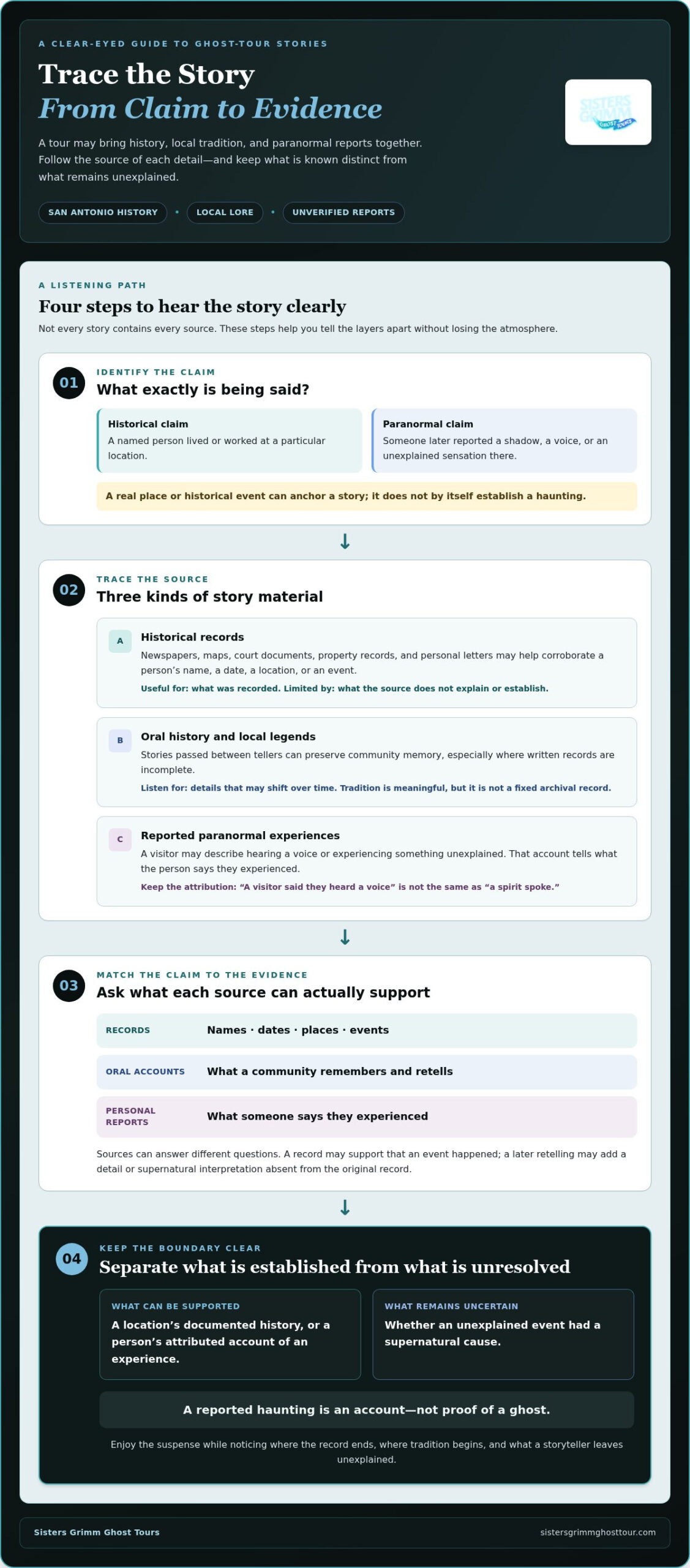
How to Listen Critically on a Ghost Tour Without Losing the Atmosphere
A guide lowers their voice. The street grows quiet. A shadowy tale begins. You don’t have to choose between enjoying the moment and thinking carefully about what you’re hearing. Curiosity can make the story more vivid, because you’ll notice not only the dramatic details but also how the account is framed.
Try this simple listening framework: identify the claim, its source, and its uncertainty. Is the guide describing a documented event, retelling a local tradition, or sharing a reported experience? Who or what is the source? Which parts are established, and which remain open to interpretation? These questions help you hear the story’s layers without demanding that every mystery be solved on the spot.
What questions help you separate fact from storytelling?
Listen for language that signals the difference between a record and a report. Phrases such as “records show,” “local tradition holds,” or “a visitor reported” point to distinct kinds of sources. A pause for atmosphere, a vivid description, or a dramatic voice can shape how a story feels, but delivery alone doesn’t change its documented basis.
If a source isn’t mentioned, treat that as a reason to remain unsure, not as proof that a claim is either true or false. Skepticism can be respectful. You can question how a story is supported while recognizing that a legend may matter to the people and community who have carried it forward.
How can visitors explore San Antonio lore respectfully?
Remember that stories may involve real people, difficult events, and places with meaning beyond their reputation for being haunted. Listen with care, and avoid turning someone’s suffering or a community tradition into a punchline. Entertainment and respect can share the same path, especially when a guide makes room for both historical context and mystery.
For more local context, look for the article Haunted San Antonio Legends. A focused example can also help you consider how a single site’s story is told: The Haunted History of the Emily Morgan Hotel. As you read, ask what is documented, what comes from tradition, and what is presented as a reported experience.
San Antonio lore rewards attention. Let the storyteller build the scene, then notice where evidence, memory, and interpretation meet. You can leave room for wonder without treating every claim as established fact, and be discerning without dismissing the people who share these stories. To experience local history and lore as a guided story, explore Sisters Grimm Ghost Tours.
How Sisters Grimm Ghost Tours Connect San Antonio History and Legend
San Antonio’s past offers more than dates and landmarks. It holds stories people have preserved, retold, and sometimes surrounded with a shiver. Sisters Grimm Ghost Tours brings historical insight, local legends, and entertaining storytelling together, giving visitors a way to experience the city’s history with a little mystery in the air. The company is locally owned by Lauren and Angelique, who founded it in 2011.
That blend leaves room for both context and curiosity. A guide can share what’s known about a place, then introduce the lore or reported experiences associated with it without presenting every supernatural interpretation as proven. Questions belong in the experience, too. Ask what’s documented, what comes from local tradition, and what remains a mystery.
What kind of stories can visitors encounter in San Antonio?
Expect a mix of local history, cultural context, and spooky lore rather than a single kind of tale. The city’s places have their own stories, and the way those stories are remembered can be as intriguing as the eerie details. A careful account makes space for the people and history behind a legend, while keeping reported paranormal experiences in the category of claims, not confirmed fact.
For a look at the bus-tour format, The Ultimate Ghost Bus Tour in San Antonio offers a related resource. It can help you picture how a guided experience carries stories between locations, while the history and lore give each stop its own atmosphere.
Can a ghost tour be both educational and entertaining?
Absolutely. Historical context gives a spooky story depth: it helps visitors understand why a place matters and how its reputation took shape. Storytelling adds rhythm, suspense, and a touch of theatrical flair. Neither element has to cancel out the other. The experience can be engaging and informative without promising a supernatural encounter or claiming that every chilling detail is established history.
Sisters Grimm’s guided experiences connect visitors with San Antonio history and local lore in a welcoming, story-driven setting. You don’t need to arrive convinced that ghosts are real to enjoy the questions a legend raises. History lovers can follow the setting and context; skeptics can listen for the line between evidence and interpretation; curious visitors can simply enjoy the atmosphere. All are welcome on a tale-filled journey through the city.
If you’re ready to experience San Antonio’s history and legends with a local guide, explore Sisters Grimm ghost tours.
Let San Antonio’s Stories Spark Your Next Adventure
On your next evening in San Antonio, let a familiar street become a setting for discovery. Notice the details around you: the age of a building, the character of a quiet corner, and the way a guide’s words can make the past feel close. The question “are ghost tours based on true stories” can lead to a richer experience when you bring both imagination and a thoughtful ear.
You don’t need to arrive with a firm belief about ghosts. Bring your curiosity instead. Enjoy the atmosphere, consider the stories, and decide for yourself which details linger after the tour ends. Sometimes the most memorable part isn’t reaching a final answer. It’s seeing a place with fresh eyes and carrying a new question home.
Ready to discover San Antonio through stories that leave room for history and mystery? Explore Sisters Grimm ghost tours and choose a guided experience for your next city adventure. Skeptics, history lovers, and the simply curious are all welcome.
Frequently Asked Questions
Are ghost tours based on true stories?
Some parts may be grounded in real people, places, or events, while other details come from local tradition or a storyteller’s interpretation. If you’re asking, “are ghost tours based on true stories,” listen for how a guide describes the source of each part. On a San Antonio tour, enjoy the setting and consider which details come from historical research, local lore, or a reported experience.
Do ghost tour guides use historical sources?
Many guides draw on sources such as newspaper accounts, maps, letters, and other historical records to give a story its setting. Sources vary by tale, and a record may support some details without settling every question about what happened. As you listen in San Antonio, notice whether the guide names a source or describes the account as tradition, and consider what that source can actually establish.
Are ghosts scientifically proven to exist?
No, ghosts have not been scientifically proven to exist. People may sincerely describe unusual experiences, but an experience or report doesn’t by itself establish a supernatural cause. On a tour, you can take someone’s account seriously as a personal report without treating it as scientific confirmation. That leaves room for both careful thinking and the thrill of hearing a story unfold in an atmospheric San Antonio setting.
Can a ghost story be partly true and partly legend?
Yes. A story might involve a real San Antonio place or person, while a later version adds dialogue, motives, or eerie details that aren’t supported by historical sources. Treat each element separately: the setting may be documented, the tale may be part of local tradition, and a paranormal detail may come from someone’s report. This layered approach lets you appreciate a story without assuming every detail has the same evidence behind it.
Are ghost tours appropriate for children?
It depends on the child’s age, comfort with spooky themes, and the tour’s age guidance. Sisters Grimm’s Haunted History Ghost Walk is listed for all ages; the Ghost Bus Tour is for ages 13 and older, and the Haunted Pub Crawl is for guests 21 and older. Consider whether your child enjoys suspenseful stories before choosing. Families traveling from Dallas, Austin, Houston, or Fort Worth can plan with those age distinctions in mind.
Do ghost tours guarantee that you will experience paranormal activity?
No, a ghost tour can’t promise that you’ll see, hear, or feel anything paranormal. The experience is a guided way to encounter stories, history, and atmosphere, not a guaranteed supernatural event. You might notice a chill or an unexpected sound, but those sensations don’t establish a ghostly cause. Enjoy the evening for the tales and places themselves, and let any unexplained moment remain just that: unexplained.
Why do people believe certain places are haunted?
Belief can grow from a place’s history, stories repeated over time, personal experiences, and the way an environment feels after dark. A building’s reputation can also shape what visitors expect to notice, making an ordinary sound feel more mysterious. In San Antonio, a guide can add local context to a site’s reputation, while visitors decide how they interpret its stories and atmosphere for themselves.