
What if a hotel’s most compelling ghost stories begin with history, not proof of the paranormal? The Emily Morgan hotel ghost stories draw their atmosphere from a building with a documented past: it opened in 1924 as the Medical Arts Building and later became a hotel. Its location near the Alamo and its former medical use help explain why the building invites eerie tales. But a story repeated around town is not the same as a verified historical record, and a chilling account does not prove a haunting.
If you’ve found online retellings hard to separate from evidence, you’re not alone. This guide explores the story themes associated with the Emily Morgan, what the building’s history can tell us, and where local lore begins. We’ll keep the mystery without presenting paranormal claims as established fact. You’ll also find a respectful way to experience San Antonio’s haunted-history storytelling, including guided Sisters Grimm ghost walks and bus tours that bring local history and legends into the city’s nighttime atmosphere. Come curious, keep a little room for wonder, and let the stories speak for themselves.
Key Takeaways
- Explore the Emily Morgan hotel ghost stories as reported accounts and local legends, not automatic proof of paranormal activity.
- Learn how to distinguish verifiable historical records, attributed testimony, and supernatural interpretations.
- Use a practical source-checking approach to assess a ghost story before repeating it as fact.
- Explore San Antonio’s haunted-history storytelling respectfully by following property rules and honoring guests’ and staff’s privacy.
- Discover how a guided local ghost walk or bus tour can place city legends in broader historical and cultural context.
Why Is the Emily Morgan Hotel Linked to Ghost Stories?
In downtown San Antonio, the Emily Morgan Hotel stands near one of Texas’s most recognized historic landmarks. Its ornate historic presence is striking by day, while its reputation for eerie tales adds another layer of intrigue after dark. But what does it mean to call a place haunted? A ghost story is a reported or retold account, not proof that paranormal activity occurred. That distinction lets us explore the mystery without mistaking a compelling tale for a verified event.
Where Is the Emily Morgan Hotel in San Antonio?
The hotel is in downtown San Antonio, close to the Alamo. The setting brings the city’s built history and familiar stories into close view, but proximity alone does not establish a connection between a particular historical event and a haunting. The building opened in 1924 as the Medical Arts Building before becoming a hotel. For an overview of its origins and historic status, see this Emily Morgan Hotel history.
How Did the Hotel Become Part of Local Haunted Lore?
Historic buildings can become natural stages for storytelling: a past use, an evocative setting, and a reported experience may be woven together over time. The Emily Morgan’s former medical use gives its ghost-story reputation an atmospheric backdrop, but that context does not verify a supernatural claim.
The hotel’s haunted reputation appears in tourism and local storytelling, while the hotel itself has acknowledged that some mysterious-seeming events can have ordinary explanations. These sources show that the stories are being told, not that every reported event happened as described. When the same detail appears across multiple retellings, it may still trace back to one account rather than several independent witnesses.
That’s why this article treats the Emily Morgan hotel ghost stories as layered local lore. As we examine individual accounts, we’ll distinguish firsthand reports from secondhand tales and recurring legends, and keep each claim connected to its source. If a detail cannot be traced to an identifiable account, it should not be presented as established fact. The history is intriguing on its own; the unexplained can remain unexplained.
Emily Morgan Hotel Ghost Stories: The Accounts Readers Hear About
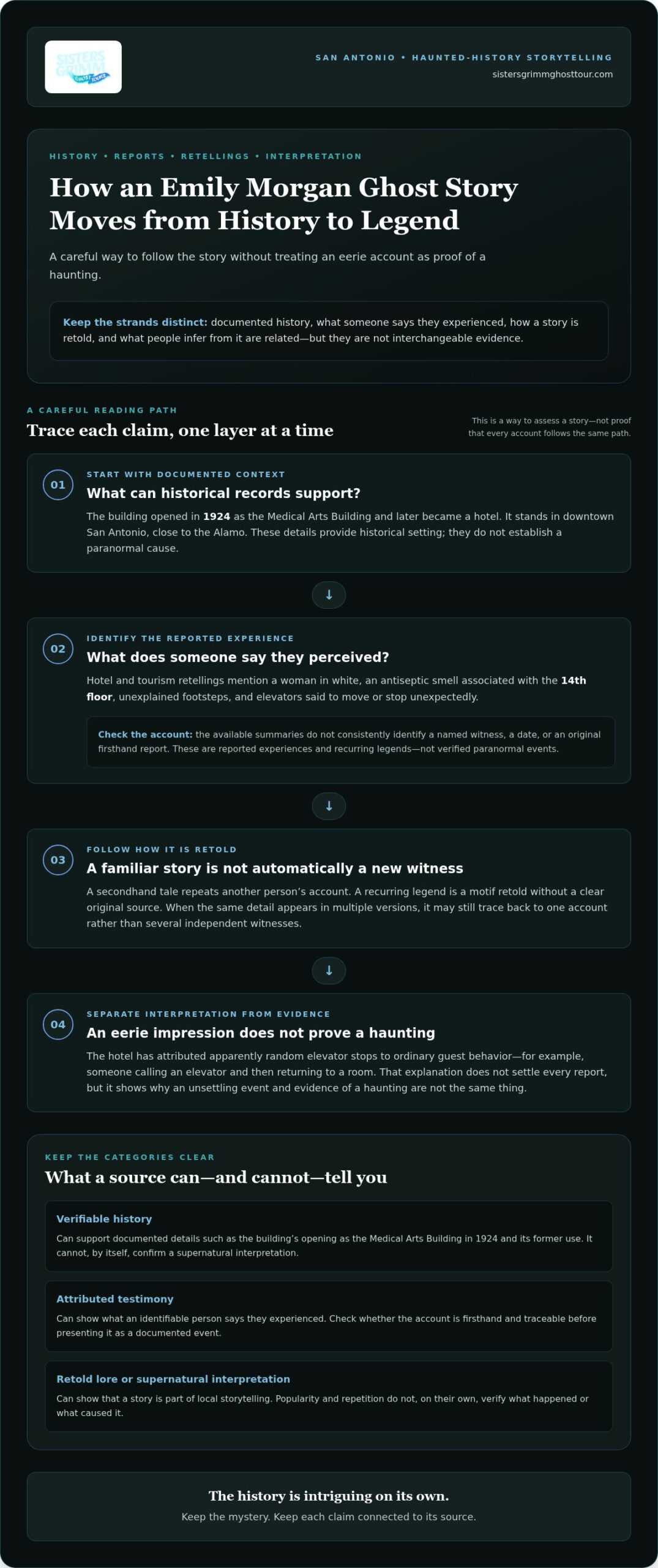
The Emily Morgan’s reputation travels through a handful of familiar motifs, but the details are not all equally well documented. Published hotel and tourism retellings mention a woman in white, an antiseptic smell associated with the 14th floor, unexplained footsteps, and elevators said to move or stop without an obvious reason. These are reported experiences and recurring legends, not verified paranormal events. The material available for these accounts does not consistently identify a named witness, date, or original firsthand report.
Reported Sightings and Unexplained Experiences
The woman in white: A recurring reported-sighting motif in hotel and tourism retellings. Without an identified witness or traceable first-person account, it is best treated as a retold story rather than a documented sighting.
Antiseptic scent and footsteps: These sensory details also appear in summaries of reported activity, with retellings associating the antiseptic smell with the 14th floor. The accounts do not establish who experienced them or when, so they should not be presented as confirmed events.
Elevators stopping unexpectedly: This story has a useful counterpoint. The hotel’s website has attributed apparently random elevator stops to ordinary guest behavior, such as someone calling an elevator and then returning to a room. That explanation does not settle every report, but it shows why an eerie impression and evidence of a haunting are not the same thing.
Recurring Hotel Legends and Their Retellings
The building’s documented past helps explain why its stories linger. The Texas State Historical Association’s history of the Medical Arts Building provides context for its former medical use. That history is verifiable; a supernatural interpretation is not. The building’s past may shape how a reported smell or sound is understood, but it cannot confirm what caused it.
Here’s the careful distinction: a reported experience describes what someone says they perceived; a secondhand tale repeats another person’s account; a recurring legend is a motif retold without a clear original source. The available summaries do not reliably establish that every version of these stories is independent or identical. The Emily Morgan hotel ghost stories are most compelling when their atmosphere stays intact and their evidence stays clearly labeled.
Curious to hear San Antonio’s wider history and legends in context? A guided San Antonio ghost tour offers another way to explore the city’s haunted-history storytelling without assuming every tale is fact.
Are the Emily Morgan Hotel Ghost Stories True?
The honest answer: the stories are part of the hotel’s reputation, but their popularity does not prove paranormal activity. The Emily Morgan hotel ghost stories sit at the intersection of documented history, people’s accounts, and supernatural interpretation. Those are related strands, not interchangeable kinds of evidence.
Use this guide to separate what a source can support from what remains a matter of belief:
| Evidence type | What it can establish | What it can’t establish on its own |
|---|---|---|
| Verifiable records | Building dates, former uses, and other details documented in historical records. | That a ghost exists or caused an unexplained event. |
| Attributed testimony | That a particular person reported an experience, if the source identifies the person and account. | That the reported cause was paranormal or independently verified. |
| Supernatural interpretation | How a storyteller or witness understands an event. | Proof that the interpretation is the only explanation. |
What Can Historical Records Confirm?
Reliable historical sources can establish the building’s documented story, including its origin as the Medical Arts Building and its use before becoming a hotel. The Texas State Historical Association’s account is a useful reference for that history. Such records provide context for the setting; they do not verify later claims of apparitions, unusual sounds, or other paranormal activity. Keep the building’s past distinct from what people later say they experienced.
What Counts as a Paranormal Report?
A paranormal report is testimony: someone’s account of what they perceived and how they interpreted it. A well-attributed report can document that the person made the claim, not that a ghost caused the experience. When several websites repeat the same tale, they may all be drawing from one source rather than offering independent corroboration. That does not make the story meaningless; it clarifies what kind of evidence it is.
Documented history can tell us what the hotel was; unverified paranormal claims tell us how some people interpret what they’ve experienced there. That distinction leaves room for curiosity without overstating the evidence. Ask practical source questions: Who first reported it? Is the account firsthand? Does a reliable source identify where and when it happened? If those details are missing, treat the tale as folklore, not established fact.
How to Explore the Emily Morgan Hotel’s Stories Respectfully
A good ghost-story visit leaves room for atmosphere and good judgment. The Emily Morgan is a hotel, not an open-air exhibit, so enjoy its public-facing downtown setting without entering guest areas or investigating private spaces. Keep your curiosity lively and your footprint light.
Plan a History-Minded Downtown Visit
The hotel’s proximity to the Alamo offers a useful geographic starting point for understanding downtown San Antonio. It does not prove a haunting or connect a particular legend to a historical event. Before visiting nearby attractions, use the relevant venue’s current public access information. From public streets, you can take in the surrounding streetscape; follow posted rules and do not approach restricted areas.
Use this simple sequence to explore a story thoughtfully:
- Research the story. Find the original source or the earliest account you can trace.
- Verify the source. Look for an identified witness, a date, or a reputable historical reference, and note what remains uncertain.
- Respect the property. Follow posted rules, respect hotel guests and staff, and leave private spaces private.
- Reflect afterward. Separate what you observed from what a story suggested you might see or hear.
Tell a Tour Story from a Historical Record
As you listen to a guide or read a retelling, notice whether the account is identified as a legend, attributed to a witness, or supported by a historical source. These labels matter. A tour story can be vivid and meaningful without functioning as a historical record, while a historical record can describe the building without proving or disproving a supernatural explanation.
Before sharing a tale as history, note who told it and what source they cited. For more context on the building’s place in local storytelling, read The Haunted History of the Emily Morgan Hotel. You can then carry that source-aware curiosity into stories elsewhere in the city.
Want to hear San Antonio legends alongside local history in a guided setting? Explore San Antonio ghost tour experiences with Sisters Grimm for a local storytelling experience that places history, mystery, and legends in context.
Keep Exploring San Antonio’s Haunted History with Local Storytellers
The Emily Morgan’s tales are one thread in a much larger tapestry of San Antonio history and folklore. The city’s stories take shape through places, documented events, and the people who retell them. A guide can help connect those strands, explaining what’s part of the historical record, what belongs to local legend, and how a story has changed over time. That context can make a tale more intriguing, not less. It gives you more than a shiver; it gives you a sense of the city behind it.
Why Local Context Adds to a Ghost Story
A building’s documented past can help explain why a legend gathers around it, while retellings show how people have interpreted the place and its atmosphere. Neither history nor a guide’s account proves paranormal activity. The value is in hearing the story clearly, understanding what supports it, and treating San Antonio’s past with care. Stay curious, and keep the sources in view.
Choose a San Antonio Storytelling Experience
Sisters Grimm Ghost Tours offers guided San Antonio experiences that bring together local history, mystery, and legends. Founded in 2011 and locally owned by Lauren and Angelique, the company offers walking, bus-based, and private tour formats. Each gives you a way to explore the city’s haunted-history storytelling in context.
If the Emily Morgan hotel ghost stories have sparked your curiosity, let them lead you into the wider collection of San Antonio tales. A guided experience can offer a storyteller’s perspective while leaving room to decide what you believe. Explore Sisters Grimm ghost tours and choose a local storytelling experience for your next San Antonio adventure.
Let San Antonio’s Stories Lead the Way
The Emily Morgan’s reputation is woven from documented building history, attributed reports, and legends passed from storyteller to storyteller. The Emily Morgan hotel ghost stories may stir the imagination, but a tale’s popularity is not proof of a haunting. Keeping history and paranormal interpretation distinct lets you enjoy the mystery while respecting the people and past behind it.
The hotel is only one chapter in San Antonio’s rich folklore. A guided local experience can bring history, mystery, and legends together, offering context as well as atmosphere. Sisters Grimm Ghost Tours, locally owned and operated by Lauren and Angelique, has been sharing San Antonio stories since 2011.
Ready to discover more of the city’s haunted-history tales? Explore Sisters Grimm’s San Antonio ghost tours and choose a guided experience that suits your curiosity. Bring an open mind, a thoughtful approach, and a little room for wonder. The next story is waiting.
Frequently Asked Questions
What ghost stories are associated with the Emily Morgan Hotel?
Published hotel and tourism retellings associate the hotel with a woman in white, an antiseptic smell, unexplained footsteps, and elevators stopping unexpectedly. These are recurring legends or reported experiences, but the summaries do not consistently identify a firsthand witness, date, or original account, so they should not be presented as verified events. The hotel has also offered an ordinary explanation for some elevator stops. None of these stories proves a ghost exists.
Is the Emily Morgan Hotel really haunted?
There’s no established evidence that the hotel is haunted. It’s associated with paranormal stories, but a person’s report and a supernatural explanation are different claims. Historical records can verify aspects of the building’s past; they do not establish that a ghost caused an experience. You can enjoy the tales as San Antonio folklore while keeping that distinction clear. A haunting has not been scientifically confirmed by the information discussed here.
Why is the Emily Morgan Hotel considered haunted?
The hotel’s reputation comes from reported experiences, later retellings, and its historic downtown setting, rather than one settled origin story. The building opened in 1924 as the Medical Arts Building and later became a hotel, according to historical accounts. That past helps explain the stories’ atmosphere, but it does not prove a paranormal connection. Treat each claimed explanation as a retelling unless a source supports its details.
Is the Emily Morgan Hotel near the Alamo?
Yes. The Emily Morgan Hotel is in downtown San Antonio near the Alamo, making the landmark a useful point of reference when orienting yourself in the area. Proximity is geographic context, not evidence for a haunting. If you’re planning a visit to the Alamo or another nearby venue, use that location’s current visitor information for access details. No specific distance or directions are needed to understand the hotel’s general location.
Can visitors explore the Emily Morgan Hotel’s ghost stories?
Yes, visitors can explore the stories through historical references and attributed retellings while respecting hotel guests, staff, posted rules, and private areas. The hotel is an operating property, so keep to areas open to the public. For a wider San Antonio storytelling experience, Sisters Grimm offers guided tours blending local history, mystery, and legends.
What is the difference between Emily Morgan Hotel history and its ghost stories?
Hotel history covers details supported by reliable records, such as the building’s documented dates and uses. Ghost stories are reported experiences, retellings, and interpretations that can vary from one storyteller to another. A story may refer to a real place or historical detail, but that link does not verify a paranormal explanation. Keep each claim labeled by its source and evidence, and the distinction between history and folklore stays clear.
Can I visit the Emily Morgan Hotel on a San Antonio ghost tour?
Sisters Grimm offers guided San Antonio ghost-tour experiences that blend history, mystery, and local legends in walking, bus-based, and private formats. Visitors planning a San Antonio trip from Austin, Dallas, Houston, or Fort Worth can explore the tour options and choose a format that suits their plans. The experience offers a way to hear the city’s stories alongside its history.