
What if the most intriguing part of the haunted landmarks in San Antonio is knowing where history ends and legend begins? Visitors are drawn to tales of restless spirits, but a dramatic story isn’t automatically a documented fact. And a famous site’s reputation doesn’t mean every part of it is open to explore.
If you’ve found history, paranormal claims, and tour promotions tangled together in search results, you’re not alone. This guide separates historical context from local lore, so you can enjoy the mystery without mistaking a ghost story for proof. Traveling to San Antonio from Dallas, Austin, Houston, or Fort Worth? Check each landmark’s current access and visitor rules before planning a stop.
We’ll look at landmarks associated with eerie tales, including the Alamo, the Menger Hotel, the Emily Morgan Hotel, San Fernando Cathedral, and historic cemeteries. Along the way, you’ll find practical reminders to check access before visiting, stick to public areas, and treat these places as more than spooky backdrops. Curious, not credulous. Respectful, with room for a little wonder.
Key Takeaways
- Explore haunted landmarks in San Antonio with a history-first lens: reported experiences and local legends are not proof of paranormal activity.
- Look for each site’s historical context, the source of its ghost story, and the evidence behind it to distinguish documented facts from folklore.
- Before visiting, check access and hours, plan transportation, and follow the site’s rules. Policies can change.
- Check original reporting and independent historical references before repeating neighborhood stories.
- A guided experience can bring local history and legends together. Sisters Grimm is locally owned and has operated in San Antonio since 2011.
What Makes a San Antonio Landmark Haunted? Start with History and Local Lore
A haunted landmark isn’t a place with supernatural activity proven beyond doubt. It’s a site connected to reported experiences, folklore, or a history people find haunting. The distinction matters: a witness may sincerely describe an unexplained sound or sighting, but that account alone doesn’t establish what caused it.
San Antonio’s stories gather around places where the past feels close. Historic buildings, changing neighborhoods, and generations of oral storytelling give local legends room to take shape. Architecture can add atmosphere: shadowed corridors, old stone, and quiet courtyards invite the imagination to fill in what the record leaves unanswered. They create a mood, not proof.
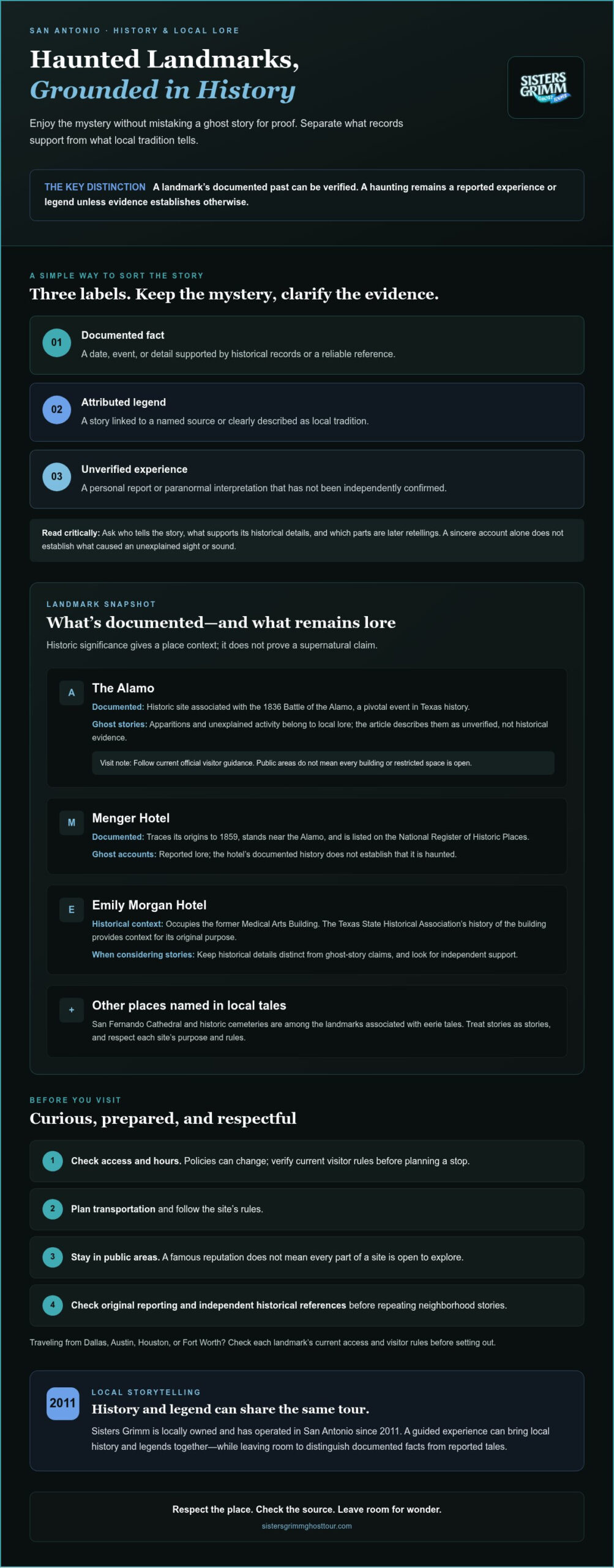
When researching haunted landmarks in San Antonio, sort details into three categories:
- Documented fact: A date, event, or detail supported by historical records or a reliable reference.
- Attributed legend: A story linked to a named source or clearly described as local tradition.
- Unverified experience: A personal report or paranormal interpretation that hasn’t been independently confirmed.
These categories let history and mystery share the same page without confusing one for the other.
How to read a ghost story without mistaking it for a historical record
Ask who tells the story and what evidence supports its historical details. A named witness, published account, or clearly identified local tradition gives readers context. Treat a tale repeated without attribution cautiously. Separate documented dates and events from later retellings, and don’t present a supernatural explanation as independently verified fact. The story can still be compelling. Just give it the right label.
Why San Antonio’s historic setting invites ghost stories
The Alamo and San Fernando Cathedral are meaningful historical landmarks, not evidence of hauntings. Their place in a city shaped by layered histories helps explain why people attach stories to particular sites, but history doesn’t prove a supernatural claim. The Menger Hotel offers a useful example of how to ground the setting: the Menger Hotel traces its origins to 1859, stands near the Alamo, and is listed on the National Register of Historic Places. Those are historical details. Ghost accounts associated with the hotel belong in the legend or reported-experience category unless independently substantiated.
A documented event tells us what the historical record supports; a legend tells us how people have chosen to remember or imagine it. That distinction doesn’t drain the wonder from a ghost story. It gives you a clearer way to enjoy the tale, honor the place, and decide what remains unknown.
Downtown Haunted Landmarks in San Antonio: The Alamo, the Menger, and Emily Morgan
Downtown’s ghost stories gather around places with documented pasts and vivid local reputations. A landmark’s history can be verified, while a haunting remains a reported legend unless evidence establishes otherwise. Here’s what the stories can tell us, and what they can’t.
The Alamo and the stories attached to a historic site
The Alamo is a historic site associated with the 1836 Battle of the Alamo, a pivotal event in Texas history. Stories of apparitions and unexplained activity are part of local ghost lore, but without a clearly identified, independently verified account, they should be treated as tradition rather than historical evidence.
Evidence status: The site’s historical significance is documented; its ghost stories are unverified. Plan your visit around current official visitor guidance. Access to designated public areas doesn’t mean every building or restricted space is open to visitors, so check site rules before you go.
The Menger Hotel and Emily Morgan Hotel: history beside hotel lore
The Menger Hotel dates to 1859 and stands near the Alamo. Its age and setting help explain its place in local ghost-tour lore, but reports associated with the hotel don’t establish that it’s haunted. Evidence status: Documented hotel history; supernatural claims remain reported lore.
The Emily Morgan Hotel occupies the former Medical Arts Building. The Texas State Historical Association’s history of the Medical Arts Building provides context for the building’s original purpose. Stories connecting the property’s past with unexplained experiences are part of its haunted reputation, not proof of paranormal activity. For a closer look at the story and its context, read about the haunted history of the Emily Morgan Hotel. Evidence status: Building history is documented; ghost accounts are unverified reports.
Hotel lobbies may be accessible to visitors, but don’t assume you can enter guest floors or other private areas. Check each hotel’s current visitor policies before stopping by. A guided experience can bring local history and storytelling together. Sisters Grimm offers San Antonio tours, but check current routes rather than assuming a particular landmark is included. Explore its local ghost tour experiences as one option.
Beyond Downtown: San Antonio Neighborhood Legends and South Side Stories
Neighborhood ghost stories can feel especially vivid because they’re tied to places people pass every day. But a headline promising a roundup isn’t enough to verify a location or a claim. Before repeating a South Side story, confirm the place’s exact name, check its history against an independent reference, and identify where the legend came from.
A responsible guide to haunted landmarks in San Antonio should give readers enough context to assess a story and visit safely, if access is permitted. Without a clear location, historical context, and attributed source, a tale may be entertaining, but its details are difficult to evaluate.
What to verify before including a South Side legend
Start with the original reporting. Confirm the location’s exact name and neighborhood, then check its history against an independent reference. Establish whether it’s public, privately owned, or no longer accessible, and look for current visitor guidance. If the story is an urban legend, identify its source and describe it as such. Don’t treat a headline as evidence.
How local oral histories add detail without replacing evidence
Oral accounts can preserve how residents remember a place, including details formal records may not capture. Their value grows when a guide identifies who shared the story and when it was recorded. A firsthand account differs from a tale repeated over time, and neither automatically confirms a paranormal explanation. Treat the account as part of the community’s storytelling history, not a substitute for historical documentation.
When you encounter a neighborhood legend, ask three questions: What’s documented about the site? Who first told or recorded the story? Can visitors access the location without disturbing residents or businesses? If access isn’t clearly public, admire the story from a distance. Don’t approach private property, linger outside homes, or make a disruptive nighttime visit.
Explore haunted San Antonio legends as stories to investigate, not automatic proof of a haunting. Checking the source keeps the mystery alive while showing respect for the people and places behind it.
How to Visit Haunted Landmarks in San Antonio Safely and Respectfully
A ghost story can make a quiet street feel full of possibility. A thoughtful visit keeps that sense of wonder from becoming a disturbance. Historic, religious, and working sites are part of living communities, not just atmospheric backdrops. Before setting out to explore haunted landmarks in San Antonio, use this four-step checklist:
- Check access: Confirm whether the site and the specific areas you hope to see are open to visitors.
- Confirm hours: Review current official information shortly before your visit. Hours and policies can change.
- Plan transport: Check walking distances, weather, parking or transit options, and how you’ll get back.
- Follow site rules: Use authorized paths, observe signs, and respect staff instructions and restricted areas.
Keep the mood curious, not intrusive. Speak quietly near places of worship, avoid disrupting residents and businesses, and leave historic spaces as you found them. If visitor guidance is unclear, contact the site operator instead of relying on an old post or an assumption.
Can you visit a haunted landmark after dark?
Don’t assume public access continues after a venue closes. A building’s exterior may be visible from a public sidewalk, while its interior, grounds, or courtyards may have different restrictions. Verify current hours and access rules directly with the site operator before going, especially if your plan depends on visiting at night. If access isn’t clearly permitted, admire the exterior from a public place and move on.
A ghost story never grants permission to enter private property. A locked gate, closed building, or posted restriction is a clear boundary, not an invitation to investigate.
A respectful plan for exploring San Antonio’s historic sites
Think through the practical details before you leave: how far you’ll walk, what the weather may be like, and whether your return transport is arranged. Stick to sidewalks and authorized paths. Don’t enter closed areas, cross private property, linger outside homes, or disturb worshippers, staff, residents, and nearby businesses for a better look or photograph.
Want to hear local stories alongside historical context? Consider a Sisters Grimm guided ghost tour, and check its current details and route before booking. Wherever you explore, respect the place, respect the people, and leave the trespassing to the fictional spirits.
Explore San Antonio’s Haunted History with a Local Storyteller
After exploring the landmarks and checking their access, you may want a guide to help connect the city’s stories. A thoughtful guide can place a local legend beside the history it grew from, explain what’s documented, and make clear when an account belongs to folklore or personal report. That context adds texture without turning a ghost story into proof.
Sisters Grimm Ghost Tours is locally owned and operated by Lauren and Angelique. Founded in 2011, the company offers guided San Antonio experiences that include walking, bus-based, pub-crawl, and private tour options. A guided outing can give your evening structure and introduce stories you might not encounter on your own. Check the current itinerary before expecting a particular landmark stop.
What a guided haunted history experience can add
A guide can help you consider not only what a place is said to be haunted by, but also how its history and legends have been told over time. Listen for the distinction between a sourced historical detail and a story shared as local tradition. Then follow up on the landmarks that catch your interest, checking reliable references and current visitor information for yourself.
For a closer look at what a walking experience can involve, read this guide to the San Antonio haunted history walk. As you compare options, check the latest route details and booking terms directly. Routes and policies can change.
Choose a San Antonio tour style that suits your evening
Prefer exploring on foot? A walking experience offers a close-up way to hear stories as you move through the city. A bus-based tour provides a different way to travel between locations. A pub crawl combines storytelling with stops at pubs, while a private tour offers a guided experience for your own party. The format alone doesn’t tell you which sites are included, so review each current itinerary before making plans.
Whichever style appeals, confirm schedules, route details, and booking terms before you go. Treat the guide as a companion to your own research, not a replacement for verifying a landmark’s history or access rules. Ready to find an experience that fits your plans? Explore Sisters Grimm ghost tours.
Let San Antonio’s Stories Lead the Way
The haunted landmarks in San Antonio are best explored with curiosity and care. Start with what history can confirm, treat ghost stories as local lore or reported experiences rather than proven fact, and check current access and site rules before you visit. The distinction doesn’t spoil the mystery. It lets the people, places, and stories each speak for themselves.
If you’d like to hear local history and legends woven together, Sisters Grimm Ghost Tours offers guided storytelling experiences in walking, bus-based, pub-crawl, and private formats. Locally owned and operated by Lauren and Angelique, the business was founded in 2011. Check current routes and details so you know what to expect.
Explore Sisters Grimm ghost tours and find a way to experience the city’s storied past that suits your plans. Keep your questions open, your visit respectful, and your imagination ready. San Antonio’s stories are waiting around the next corner.
Frequently Asked Questions About Haunted San Antonio Landmarks
Are San Antonio landmarks really haunted?
Haunting claims aren’t scientifically established facts. A landmark may have a well-documented history, while reports of strange experiences and ghost stories belong to a different category. For haunted landmarks in San Antonio, look for stories attributed to a named source or clearly identified as local tradition, and distinguish those accounts from confirmed historical records. You can enjoy the mystery while checking reliable sources for the people, events, and dates behind each place.
Which San Antonio landmark is considered the most haunted?
There’s no objective, universally accepted ranking of San Antonio’s most haunted site. The Alamo, the Menger Hotel, and the Emily Morgan Hotel are often associated with local history or ghost-story discussions, but check the source of each story. A legend’s popularity doesn’t establish paranormal activity or make one place definitively the most haunted. Treat rankings as storytelling, then look for reliable historical context and attributed accounts.
Can you visit haunted landmarks in San Antonio at night?
Nighttime access depends on each property’s hours, ownership, and current visitor rules. A public sidewalk may let you view a building’s exterior, but it doesn’t grant entry to the building or its grounds. Before setting out, check official information from the venue, respect closures, and confirm whether the area you hope to see is open. If considering a guided experience, verify its current route and schedule rather than assuming it visits a particular landmark.
Is the Emily Morgan Hotel known for ghost stories?
Yes, the Emily Morgan Hotel is frequently discussed in connection with San Antonio ghost lore, but paranormal claims haven’t been proven. Keep its verifiable building history separate from stories attributed to guests or local tradition, and check current visitor access before stopping by. For more context, read this account of the haunted history of the Emily Morgan Hotel, while treating ghost accounts as stories rather than established fact.
What haunted places are mentioned in San Antonio’s South Side legends?
Local reporting has covered South Side places and urban legends, but don’t rely on a headline alone to identify them. Confirm each named location in the original article and check its history against independent sources before repeating a story. Also verify whether the site is public and currently accessible. Share neighborhood tales with clear attribution and respect for residents. A legend isn’t an invitation to approach homes or enter private property.
Can you explore San Antonio’s haunted landmarks without a tour?
Yes, you can explore some historic sites and nearby public areas independently, subject to current hours and access rules. Check official venue information, plan your transport, and stay out of closed or private areas. A guided tour is optional and may add historical storytelling, but its itinerary can vary. Confirm the current route before booking rather than assuming a particular landmark is included. Wherever you go, follow posted rules and be considerate of the people who use the site.