
What if the white-clad figure wailing by the riverbank isn’t just a campfire story, but a centuries-old echo of a fallen empire? Most of us grew up hearing the terrifying cries of the Weeping Woman, warned that staying out too late by the water would lead to a watery grave. You’ve likely seen the Hollywood blockbusters, but they often trade deep cultural history for cheap jump scares. It’s time to peel back the cinematic mask and uncover the la llorona true story, moving beyond the fiction to the bone-chilling facts.
You’ll soon discover how this legend is far more than a simple ghost tale. We’re diving deep into the ancient Aztec omens of Cihuacoatl and the complex life of the historical figure La Malinche to see how they shaped this mystery. From colonial tragedies to the specific, shadow-drenched corners of San Antonio where her spirit is still said to wander, we’ll guide you through the historical roots of the world’s most famous haunt. Prepare to meet the real women behind the wails and see the River City through a much darker, more mysterious lens.
Key Takeaways
- Trace the chilling origins of the myth back to pre-Columbian times, where Aztec omens once predicted the fall of an entire empire.
- Separate Hollywood fiction from the la llorona true story by examining the life of La Malinche and other historical figures who may have inspired the legend.
- Understand the dark symbolism behind the Weeping Woman’s eternal penance and what her presence says about cultural trauma and betrayal.
- Identify the specific locations along the San Antonio River Walk where the rustle of the trees might just be the sound of a silk dress passing by.
- Learn how a blend of verified history and theatrical storytelling brings these ancient whispers to life for a modern audience.
What is the Legend of La Llorona? The Weeping Woman Explained
The sound of a woman crying near the water’s edge isn’t just a trick of the wind. It’s the signature of a legend that has haunted the Americas for centuries. La Llorona, or the Weeping Woman, is the vengeful spirit of a mother condemned to wander the banks of rivers and streams for all eternity. Her story is one of profound tragedy and chilling horror. She isn’t just a ghost. She’s a cultural icon whose name still makes children pull their covers a little tighter at night.
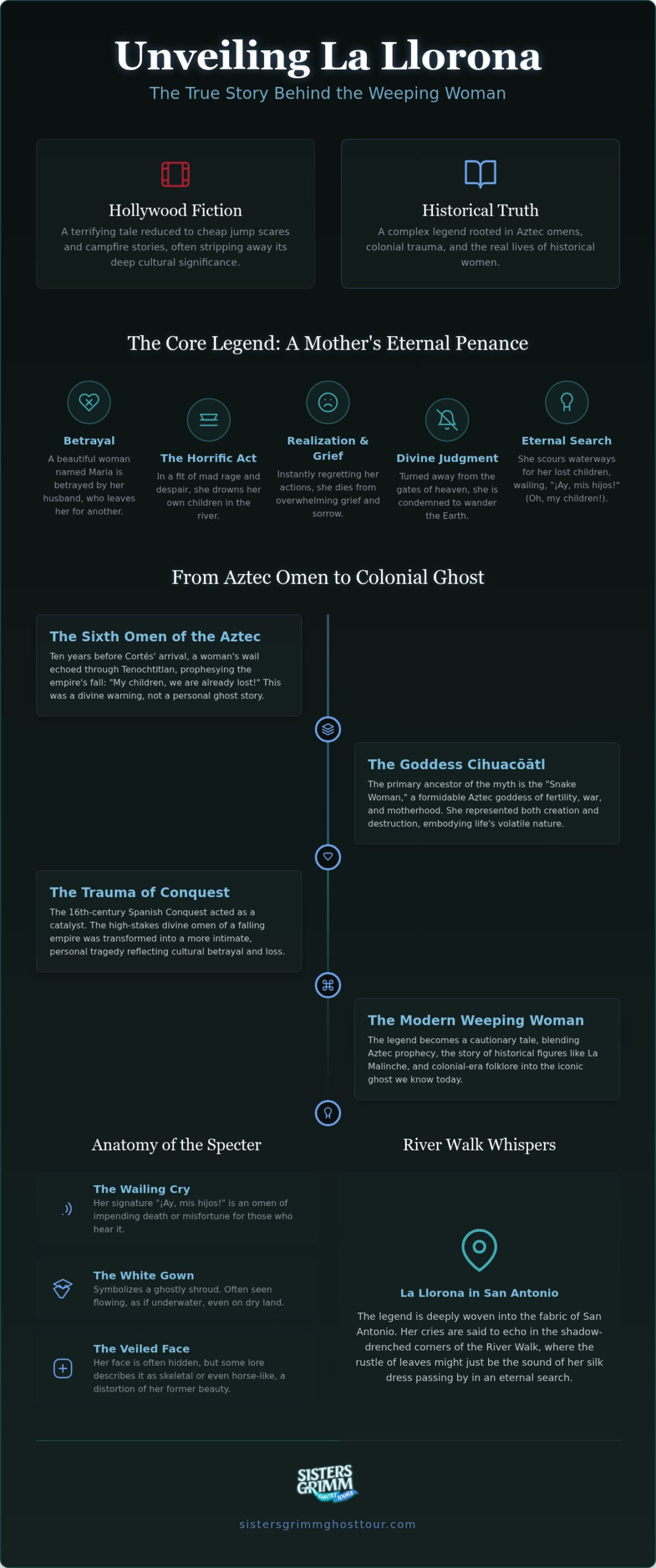
The heart of the narrative remains consistent across generations. A beautiful woman named Maria, driven to madness by the betrayal of a husband who no longer loved her, drowned her own children in a fit of desperate rage. Upon realizing the horror of her actions, she succumbed to grief and died, only to be turned away from the gates of heaven. Her penance is a never ending search. She’s forced to scour the waterways, wailing “¡Ay, mis hijos!” as she looks for the little ones she lost to the current. When people go looking for the la llorona true story, they often find that the emotional weight of her guilt is just as terrifying as her spectral form.
Hearing her cry is never a good sign. In traditional folklore, her wails serve as an omen of impending death or severe misfortune for anyone unlucky enough to cross her path. Even in 2026, her presence remains a powerful force in modern storytelling. From Hollywood blockbusters to digital creepypastas, the legend persists because it taps into a primal fear of loss and the unknown. She represents a bridge between our world and a darker, more sorrowful past. Locals don’t just fear her; they respect the gravity of her tragedy.
The Iconic Visuals of the Weeping Woman
She’s almost always seen in a flowing white gown, her face hidden behind a delicate lace veil. This shroud of mystery only adds to the dread. Water is her hunting ground, acting as a mirror for her eternal misery. In some specific regional lore, her face is described as skeletal or even horse-like, a jarring distortion of the beauty she once possessed. These visuals create an atmospheric dread that lingers long after the sun goes down.
Common Variations Across the Americas
The legend adapts to its surroundings. In Mexico City, she’s often tied to colonial architecture, while in the Southwestern United States, she haunts the dry arroyos and the lush San Antonio River Walk. The role of the unfaithful husband varies too. Sometimes he’s a Spanish nobleman, while other times he’s a local rancher. Regardless of the details, the story serves as a stark cautionary tale. Parents use her name to keep children away from dangerous waters, turning a supernatural terror into a practical safety lesson.
Ancient Origins: From Aztec Omens to Spanish Conquest
Long before the first Spanish ships appeared on the horizon, a terrifying sound echoed through the valley of Mexico. This wasn’t the cry of a heartbroken mother, but a celestial warning. To find the la llorona true story, we have to travel back to the height of the Aztec Empire, where the supernatural and the political were inextricably linked. The figure we know today as a weeping ghost began her life as a divine herald of doom.
Historians record that ten years before the arrival of Hernán Cortés, the “Sixth Omen” appeared in the night sky and the city streets. A woman was heard crying throughout Tenochtitlan, her voice carrying a weight that chilled the hearts of the Emperor and commoner alike. She wailed, “My children, we are already lost!” or “Where shall I take you?” This wasn’t a local haunting; it was a city-wide prophecy of the coming apocalypse. It signaled the end of an era and the destruction of a people.
The Aztec Goddesses of Motherhood and Death
Cihuacōātl, the “Snake Woman,” is often cited as the primary ancestor of the myth. She was a formidable goddess of fertility and war who, according to legend, would leave a sacrificial cradle at a crossroads, only for it to contain a flint knife instead of a child. This mythological woman in Mexican and Latin American oral tradition also shares traits with Coatlicue, the “Mother of Gods,” who represented both the womb and the grave. The drowning motif in the modern legend mirrors the ancient Aztec practice of child sacrifice to the rain god Tlaloc, where the tears of the victims were seen as a sacred sign of forthcoming rain. These divine figures were both creators and destroyers, embodying the volatile nature of life itself.
The 16th Century: When History Became Legend
The trauma of the Spanish Conquest acted as a powerful catalyst, transforming these high-stakes divine omens into a more intimate, personal tragedy. As Spanish settlers arrived, they brought their own folklore of “White Ladies” and vengeful spirits. These European tropes fused with the indigenous wailing goddesses, creating a new narrative that fit the changing world. The story shifted from a cosmic prophecy of doom to a river-side ghost story that resonated deeply with the emerging mestizo population. It became a way to process the literal and cultural “drowning” of their former world.
This evolution from a cosmic deity to a weeping ghost is a journey through the very soul of history. To truly feel the weight of these ancient shadows under the moonlight, you can join a Haunted History Ghost Walk and hear how these old-world omens still ripple through the modern streets of San Antonio. It’s a chance to see how the la llorona true story is still being written today.
Searching for the Real La Llorona: Historical Parallels
While we’ve explored the divine omens of the past, the hunt for the la llorona true story often leads us to flesh and blood women whose lives were as tragic as any ghost story. We naturally crave a single source. We want a “patient zero” for the wails that echo through history. However, the truth is far more complex than a single birth certificate or death record. The legend is a tapestry woven from collective memory and real historical trauma, reflecting the very real struggles of women during the tumultuous years of the Spanish Conquest and the colonial era that followed.
Why do we keep looking for her in the archives? Perhaps it’s because her grief feels too heavy to be purely imaginary. By examining historical parallels, we can see how the “Weeping Woman” became a vessel for the anxieties of a changing world. She isn’t just one woman; she’s a reflection of thousands who were caught between two worlds, left with nothing but their sorrow.
La Malinche: Traitor or Victim?
Many scholars point to Malintzin, famously known as La Malinche, as the primary human inspiration for the legend. She was the enslaved Indigenous woman who served as an interpreter and mistress to Hernán Cortés. She bore him a son, Martín, who is often regarded as one of the first mestizos. When Cortés eventually moved to solidify his standing by marrying a Spanish woman of high rank, Malintzin was cast aside. Her “betrayal” of her people by aiding the Spanish is frequently mirrored in the myth’s betrayal of her own children. While she didn’t literally drown her offspring, the loss of her heritage and the subsequent “abandonment” of her Indigenous identity created a symbolic drowning. She became the mother of a new race that felt rejected by its origins, making her the most widely known ghost in Texas and Mexico alike.
The Maria Figure in Colonial Society
As the story evolved into the version we recognize today, the protagonist took on the name “Maria.” This Maria represents the archetype of a peasant woman in colonial society who falls in love with a Spanish nobleman. In these accounts, the man eventually abandons Maria to marry someone of his own social standing. The rigid “honor” system of the time made the existence of “illegitimate” children a social death sentence for the mother. Class disparity and the unforgiving caste system fueled the realism of the legend, making the desperate act of infanticide a horrifyingly plausible outcome in the minds of a repressed public. This version of the la llorona true story isn’t about a monster; it’s about a woman driven to the brink by a society that gave her no other choice.
La Llorona in San Antonio: River Walk Whispers
San Antonio’s heart beats in rhythm with the winding water of the river. It’s a city where the past isn’t just remembered; it’s felt in the humid night air and the rustle of the cypress trees. While many regions claim a piece of the myth, the la llorona true story in this city is uniquely tied to the very stones of our historic crossings. Here, the legend isn’t just a story told to frighten children. It’s a lingering echo of the city’s complex and often violent frontier history.
The 1813 Battle of Medina, the bloodiest battle in Texas history, left a landscape scarred by the loss of nearly 1,000 men. The resulting waves of grief and the displacement of families created a lingering atmospheric trauma. Some believe this collective sorrow provided the perfect energy for the Weeping Woman to manifest. In San Antonio, she isn’t just a generic ghost. She’s a reflection of the real women who stood on these banks, searching for lost loved ones amidst the chaos of revolution and settlement.
Ghostly Encounters Near the San Antonio River
Specific reports of a wailing woman have persisted since the early days of the Spanish settlement. Locals often speak of a figure in white seen near the old Spanish crossings, where the water is deep and the shadows are long. Even as the River Walk transformed into a world-famous tourist destination, the sightings didn’t stop. The modern concrete paths and festive lights haven’t silenced the cries that rise from the water’s edge. If you want to stand on the ground where these legends breathe, the Haunted History Walk San Antonio offers a chance to explore these sites after dark.
The ‘Woman in White’ of Texas Lore
San Antonio is often called the Ghost Capital of Texas, and for good reason. Our version of La Llorona is influenced by a unique blend of cultures, including the original Canary Islander settlers who arrived in 1731. They brought their own “White Lady” traditions, which fused with the indigenous and mestizo stories already present in the region. This created a local spirit that is distinct from other Texas legends. While other ghosts might haunt old hotels or battlefields, the Weeping Woman of San Antonio remains bound to the water, a permanent fixture of our city’s spiritual landscape.
The mystery of the river is best experienced when the sun goes down and the stories come alive. To hear more about the secrets hidden beneath the surface, you can book a Ghost Bus Tour In San Antonio and see the city’s most haunted landmarks for yourself. It’s the best way to separate the facts from the folklore.
Beyond the Myth: Experience the Legend with Sisters Grimm Ghost Tours
Reading about the Weeping Woman is one thing, but standing where the damp river air clings to your skin is quite another. Step out of the digital glow and into the flickering gaslight of San Antonio’s past. Sisters Grimm Ghost Tours was founded in 2011 by local historians who understood that the la llorona true story is best told where history and mystery intersect. We don’t just recount facts. We breathe life into the shadows, acting as a bridge between the academic records of the city and the evocative, atmospheric lore that defines our culture.
Professional storytelling is the heartbeat of cultural preservation. Without it, legends like La Llorona risk becoming flat, one-dimensional caricatures in a movie trailer. At Sisters Grimm Ghost Tours, we believe the gravity of the past deserves a stage. By blending verified archival research with a spirited, theatrical delivery, we ensure these stories remain as vivid today as they were three centuries ago. We invite you to join a shared adventure where the secrets of the River City are finally unmasked.
The Ghost Bus Tour Experience
The Ghost Bus Tour in San Antonio is designed for those who want their chills served with a side of theatrical flair. You’ll travel through the city’s most haunted districts in a climate-controlled bus, making it a perfect year-round adventure. The guides at Sisters Grimm Ghost Tours are more than just experts; they are keepers of the city’s darkest lore, unearthing hidden secrets that standard history books often omit. It’s a curated journey that moves from the tragic sights of the old city to the very edges of the river where the wails are said to linger. You’ll see the sites of ancient omens and colonial tragedies without ever losing the sense of spooky fun that makes a night in San Antonio so memorable.
Walking the Path of Spirits
For those who prefer a more intimate connection with the past, the choice between a ghost walk vs bus tour often comes down to how close you want to get to the shadows. On foot, you’re standing on the very ground where the Canary Islanders built their first homes and where the 1813 Battle of Medina’s echoes might still reside. There’s a particular magic in walking the River Walk at night, away from the neon lights, where the rustle of the trees feels a little too much like a silk dress. Walking these paths is the ultimate way to feel the weight of the la llorona true story under your own feet. It’s a chance to see the world as the settlers and the Aztecs once did, where every ripple in the water might be a sign of something unexplained.
Are you ready to hear the cries for yourself? The secrets of the Weeping Woman are waiting to be discovered in the heart of the city. Book your San Antonio ghost adventure today!
Uncover the Shadows of the River City
The legend of the Weeping Woman is far more than a simple ghost story used to keep children away from the river’s edge. It’s a complex tapestry woven from ancient Aztec omens, the trauma of the Spanish Conquest, and the real-world tragedies of women like La Malinche. By exploring these historical roots, you’ve seen that the la llorona true story is actually a reflection of the collective memory of an entire continent. Whether she’s a divine herald of doom or a heartbroken mother, her wails continue to resonate through the centuries.
San Antonio remains the perfect stage for this enduring mystery. From the site of the Battle of Medina to the winding paths of the River Walk, the past is never truly buried here. Our expert guides are trained in local history and have been featured on national travel programs, ensuring you get the most authentic experience possible. As the company voted #1 Ghost Tour in San Antonio, we invite you to see the city’s dark lore through the eyes of those who know its secrets best.
Step into the shadows and hear the true story on a Sisters Grimm Ghost Tours adventure
The river is calling. Will you answer?
Frequently Asked Questions
Is La Llorona based on a true story?
The la llorona true story is a haunting blend of ancient Aztec omens and real colonial tragedies rather than a single documented police report. While there isn’t one specific woman named Maria in the archives, the legend draws from the very real experiences of indigenous and mestizo women during the Spanish Conquest. It’s a story of collective memory. These historical parallels give the myth its bone-chilling weight and lasting cultural power.
What is the real name of La Llorona?
Maria is the most common name given to the woman in traditional folklore. However, her historical identity is often tied to Malintzin, or La Malinche, the indigenous interpreter for Hernán Cortés. In various regional versions, she might be a peasant girl or a noblewoman. The name Maria likely became standard during the colonial era to fit the religious and social norms of the Spanish settlers who helped spread the tale.
Where did La Llorona drown her children?
Legend states she drowned her children in a river, though the specific location changes depending on where you hear the story. In Mexico City, it’s the ancient canals; in the Southwest, it’s often a dry arroyo that flash floods. Here in San Antonio, the sightings center on the winding banks of the River Walk. Water serves as her eternal hunting ground and her mirror of grief, regardless of the map coordinates.
What happens if you hear La Llorona cry?
Hearing her wail is traditionally considered a dark omen of impending death or severe misfortune for you or your loved ones. For some, it means a family member will soon pass away. For children, the stakes are even higher. The legend warns that she might mistake you for one of her own lost children and pull you into the depths. It’s a chilling reminder to stay away from the water after dark.
Is La Llorona and La Malinche the same person?
They are not literally the same individual, but La Malinche is the most prominent historical figure used to explain the legend’s origins. Malintzin’s role in the fall of the Aztec Empire and her relationship with Cortés created a narrative of betrayal that mirrors the ghost’s story. While one is a woman of history and the other a spirit of myth, their tragedies are forever intertwined in the Latin American psyche.
Are there La Llorona sightings in San Antonio?
Yes, locals have reported sightings near the San Antonio River Walk for generations. Most encounters happen near the old Spanish crossings where the shadows are deepest and the history is oldest. Witnesses often describe a woman in a flowing white dress wandering the banks or hear a distant, mournful cry that doesn’t sound like the wind. These sightings keep the spirit of the legend alive in our city’s modern landscape.
How do you protect yourself from La Llorona according to legend?
Traditional lore suggests using religious items like a crucifix or holy water for protection against her spirit. Some regional stories say that wearing your clothes inside out can confuse the ghost and keep her from targeting you. The most effective protection, however, is simply staying away from the water at night. It’s a cautionary tale designed to keep the curious safe from the unknown dangers of the riverbank.
Why does La Llorona wear white?
Her white gown serves as a symbol of her spectral status and her connection to ancient deities. The Aztec goddess Cihuacoatl was said to appear in white, wailing in the streets of Tenochtitlan before the Spanish arrived. This visual also links her to the “White Lady” ghost traditions of Europe. The flowing white fabric makes her easily visible in the darkness, providing a stark, terrifying contrast to the black river water.