
San Antonio’s ghost stories cluster around the Alamo, the Old Bexar County Jail, the Aztec Theatre, and historic hotels such as the Menger, Emily Morgan, and Gunter. The most haunted places in San Antonio pair reported apparitions and local legends with tangible history: the Alamo battle took place in 1836, and the Old Bexar County Jail was built in 1878. The result is a city where the past feels close, even in the glow of a hotel corridor.
It’s easy to see why visitors are drawn to the most haunted places in San Antonio: each location has its own atmosphere, history, and haunting lore. Explore stories tied to the city’s historic landmarks, learn why the old jail’s reputation endures, and discover the hotels woven into local ghostly folklore. Along the way, distinguish places you can visit from the stories that keep their shadows alive.
Key Takeaways
- Explore how San Antonio’s historic landmarks connect documented history with stories of reported apparitions.
- Learn what gives the Old Bexar County Jail its eerie reputation and which tales surround its past.
- Unpack the Gunter Hotel’s Room 636 murder legend and why it adds to the city’s haunted lore.
- Compare the stories attached to San Antonio’s historic hotels to find the kind of ghostly atmosphere that intrigues you most.
1. Ghost stories at San Antonio’s historic sites
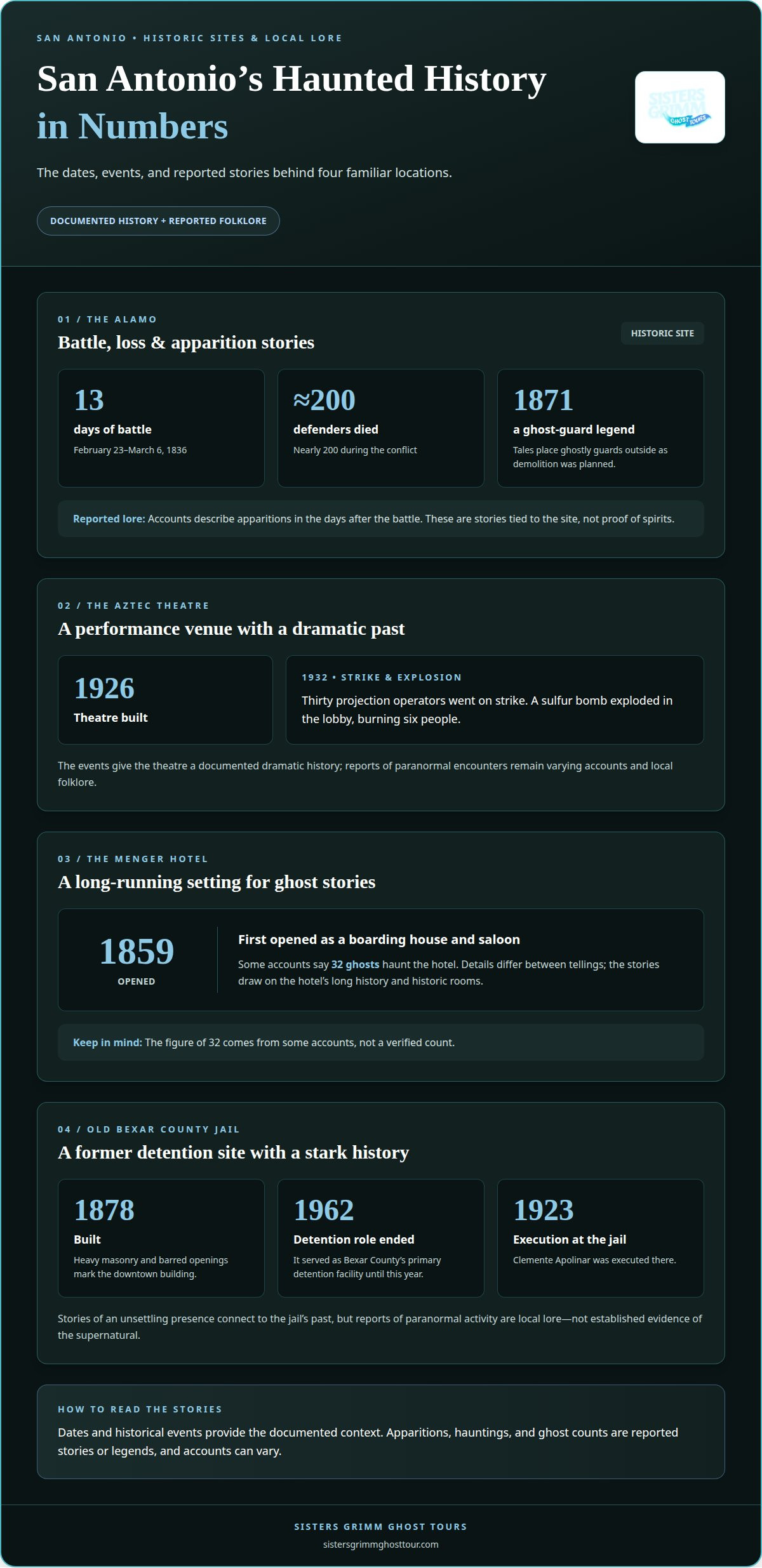
San Antonio’s historic sites hold stories shaped by conflict, performance, and the people who passed through them. Their paranormal reputations come from reported encounters and local legends, not proof of restless spirits. The Alamo, Aztec Theatre, and Menger Hotel each offer a different entry point into the city’s haunted lore.
The Aztec Theatre, built in 1926, is another stop in local ghost stories. Its history includes a 1932 strike by thirty projection operators and a sulfur bomb that exploded in the lobby, burning six people. Those events give the theater a dramatic past, while reports of paranormal encounters keep its reputation alive. The stories may focus on unexplained activity inside a performance space, but accounts vary, so treat them as folklore rather than established events.
The Menger Hotel opened as a boarding house and saloon in 1859. Some accounts say 32 ghosts haunt the hotel, making it one of the best-known settings for San Antonio legends. Its long history gives ghost stories plenty of atmosphere, from the old saloon to the hotel’s historic rooms. The details differ between tellings; that mystery is part of the appeal.
Ghost tour rules and age restrictions vary, so there is no single age limit for every San Antonio experience. Read the participation rules for the specific tour and consider whether its stories and atmosphere suit your group.
2. Old Bexar County Jail history and reported paranormal activity
Built in 1878, the Old Bexar County Jail served as Bexar County’s primary detention facility until 1962. Its heavy masonry and barred openings give the downtown building a stark presence, even before its prison stories enter the picture. For generations, the jail held people awaiting trial or serving sentences, making confinement central to its history and atmosphere.
One documented episode was the execution of Clemente Apolinar at the jail in 1923. That history has helped shape stories of spirits and reported paranormal activity inside the former detention site. Tales of an unsettling presence belong to local lore, rather than established evidence of the supernatural. Visitors who believe in hauntings may read the building’s silence differently from those drawn chiefly to its architecture and criminal history.
Downtown San Antonio adds another layer: historic stone façades, narrow streets, and older buildings place the jail among reminders of the city’s changing past. San Antonio’s Spanish colonial heritage dates to 1718, while later conflicts shaped its American and Mexican histories. At the Council House Fight in 1840, 35 Comanche and 7 Texans were killed. Such events help explain why stories of tragedy and restless spirits attach themselves to historic sites.
Victoria’s Black Swan Inn, in a building dating to the mid-19th century, is another setting surrounded by haunting stories. Local lore connects the inn with family tragedy, though the building’s age is the concrete historical detail. That distinction matters: a site’s documented past and its ghost stories can be compelling without being the same kind of account.
Historic districts broaden the picture beyond one jail or inn. The King William District’s story reaches from the 1860s to the present, with period architecture offering a visible record of San Antonio’s growth. Together, these sites show how buildings, battles, and personal tragedies become part of the city’s haunted identity.
Are San Antonio’s haunted places safe to visit at night? Choose public locations, follow posted rules, and stay with your group. A ghost story doesn’t replace ordinary nighttime awareness. The Old Bexar County Jail may have limited access, so respect boundaries and never enter restricted areas.
3. Why Is San Antonio So Haunted?
San Antonio’s haunted reputation grows through stories tied to recognizable places, from downtown hotels to railroad tracks and bridges. Each legend gives a location a memorable figure or ritual, turning a visit into a search for clues. The Gunter Hotel murder story, the powder-covered bumper, and Donkey Lady Bridge show the variety of local tales.
At the Gunter Hotel, the story centers on Walter Emerick, who checked in under a false name in February 1965. The hotel gained notoriety that year as the site of a gruesome murder. Room 636 became the setting attached to the mystery. Those details anchor the legend in a specific hotel and room, while retellings keep its darker atmosphere alive. The tale is often associated with the hotel’s long history, but the murder mystery is what gives this account its sharpest edge.
A railroad-track urban legend offers a different kind of encounter. Visitors are said to sprinkle baby powder on a car’s bumper, then wait for handprints to appear. The ritual turns a quiet stretch of track into a test of belief: the powder provides a visible surface, and any mark becomes part of the story. This simple legend’s staged moment of discovery helps explain its lasting appeal.
Donkey Lady Bridge has another eerie name in San Antonio folklore. The practical advice associated with visiting is to go with a friend. That suggestion makes the legend feel less like a hotel mystery and more like a nighttime dare shared between companions. The bridge’s name and the advice around it are concrete parts of the story, even as accounts of the haunting vary.
Historic sites also shape the city’s wider ghost lore. The Emily Morgan building served as the Medical Arts Building until 1976, connecting a former hospital setting with later hotel stories. San Antonio’s legends draw power from such changes in place and purpose. A hotel room, a railroad track, or a bridge becomes a stage where local history and imagination meet.
4. Haunted hotels in San Antonio
San Antonio’s historic hotels make ghost lore part of the setting, not just a story told outside after dark. Their architecture and changing uses offer different ways to encounter the city’s past, from a former medical building to a hotel bar tied to the Rough Riders. The Emily Morgan, Menger, Crockett, and Drury each bring a distinct chapter to the haunted-hotel conversation.
The Emily Morgan building was constructed in 1924 and later served as the Medical Arts Building, with 50 hospital beds. Local haunting stories point to Room 525 as the building’s most haunted room. The 7th, 9th, 14th, and basement floors are also identified in reports as especially haunted. USA Today named the Emily Morgan the 3rd Most Haunted Hotel in the World. Its former hospital role gives those tales a particular atmosphere, though reported ghosts remain part of folklore.
At the Menger, the hotel’s famous bar adds a historical detail beyond its ghost legends: Teddy Roosevelt recruited his Rough Riders there in 1898. The Crockett Hotel dates to 1909, placing it among the city’s older lodging landmarks. Their stories show how hotel history can draw visitors even before a ghost tale begins. Listen for the details tied to each building, rather than treating every hotel legend as the same story.
The Drury Hotel building dates to 1929. Another unusual case is the Holiday Inn listing: its building dates to 1878, but it has operated as a hotel since 2004. These different timelines help explain why visitors may encounter old architecture alongside newer hotel use. A building’s former purpose, distinctive rooms, and reported encounters all shape its reputation.
For an overnight stay, the Emily Morgan, Menger, Crockett, Drury, and Gunter are the hotel options among these locations. Historic sites that aren’t hotels are places to visit, not places to stay overnight.
Want to hear San Antonio’s legends brought to life? Explore the city’s haunted history on a guided ghost tour.
Sisters Grimm Ghost Tours: Ghost Bus Tour In San Antonio
Sisters Grimm Ghost Tours brings San Antonio’s history and local legends to life through guided storytelling. Take the Ghost Bus Tour In San Antonio for a ride through the city’s haunted lore, or explore on foot with the Haunted History Ghost Walk. The Haunted Pub Crawl: The Ghost Bus pairs ghost stories with a pub crawl, while The Unique Private Tour offers a private experience for your group.
These tours suit visitors looking for more context than a quick stop at a historic site can provide. Stories connect landmarks, local history, and reported hauntings in an educational, entertaining experience. Choose the format that fits your plans: a bus tour, a walk, a pub crawl, or a private tour.
Visit sistersgrimmghosttour.com to explore the tours.
Choose Your Own San Antonio Ghost Story
To explore the most haunted places in San Antonio, decide what kind of story you want to follow. You might be drawn to the hush of a historic hotel, the weight of a landmark’s past, or the playful tension of a local urban legend. Let curiosity lead, while remembering that reported hauntings belong to folklore, not established proof of spirits.
A guided experience can add context to the places and stories that catch your imagination. Sisters Grimm Ghost Tours brings local history and ghostly lore together, helping visitors experience San Antonio as more than a collection of eerie names. Choose the outing that suits your evening and let the stories unfold along the way.
Ready to keep exploring San Antonio’s mysterious side? Contact Sisters Grimm Ghost Tours and take the next step toward an atmospheric night of local stories. Bring your curiosity, keep an open mind, and enjoy discovering which legends linger with you.
Frequently Asked Questions
Ready to Explore San Antonio’s Dark Side?
Yes. Start by choosing whether you’d rather hear stories while walking or riding by bus. A walking tour keeps the city’s streets and architecture in view, while a bus tour offers a different way to take in local lore. If you’re planning with children, check the specific tour’s age guidance and consider whether its content is a good fit. That choice can shape the whole evening.
Why Is San Antonio So Haunted?
San Antonio’s haunted reputation comes from local legends attached to places with layered histories. Old buildings, theaters, hotels, and sites associated with conflict give storytellers vivid settings for tales of spirits and strange encounters. These accounts are part of local folklore, not proof of paranormal activity. Comparing a location’s documented history with later retellings helps you enjoy the mystery while keeping the two distinct.
What are the most haunted places in San Antonio, Texas?
The Alamo, Old Bexar County Jail, Aztec Theatre, Menger Hotel, Emily Morgan Hotel, and Gunter Hotel are among the most haunted places in San Antonio featured in local stories. For a self-guided outing, group nearby historic sites together and save hotel legends for a separate visit. Remember that a ghost story doesn’t mean every building or interior is open to the public.
What are the ghost stories and reported paranormal activity at the Alamo?
Alamo lore includes reports of apparitions appearing after the 1836 battle and ghostly guards reportedly seen outside the site in 1871. Those stories grew around a place marked by conflict and remembrance. Treat them as reported encounters rather than verified events, and approach the Alamo as a historic landmark first. That perspective leaves room for the legend without confusing folklore with the site’s documented history.
Is the Menger Hotel haunted, and what ghost sightings are reported there?
Local accounts say 32 ghosts haunt the Menger Hotel, though these sightings remain part of its folklore. The hotel’s long-standing reputation makes it a memorable setting for stories about unexplained presences. Guests interested in its history can distinguish the hotel’s documented past from supernatural claims by listening for what a tale reports, then considering what the story leaves to imagination.
Are there ghost tours in San Antonio, and which locations do they visit?
Yes. Sisters Grimm Ghost Tours offers a Ghost Bus Tour In San Antonio, a Haunted History Ghost Walk, and a Haunted Pub Crawl: The Ghost Bus. The Haunted History Ghost Walk is outdoors, so it shouldn’t be mistaken for an interior visit to the Menger or another historic building. The pub crawl is for guests aged 21 and older; the bus tour is recommended for ages 13 and older.