
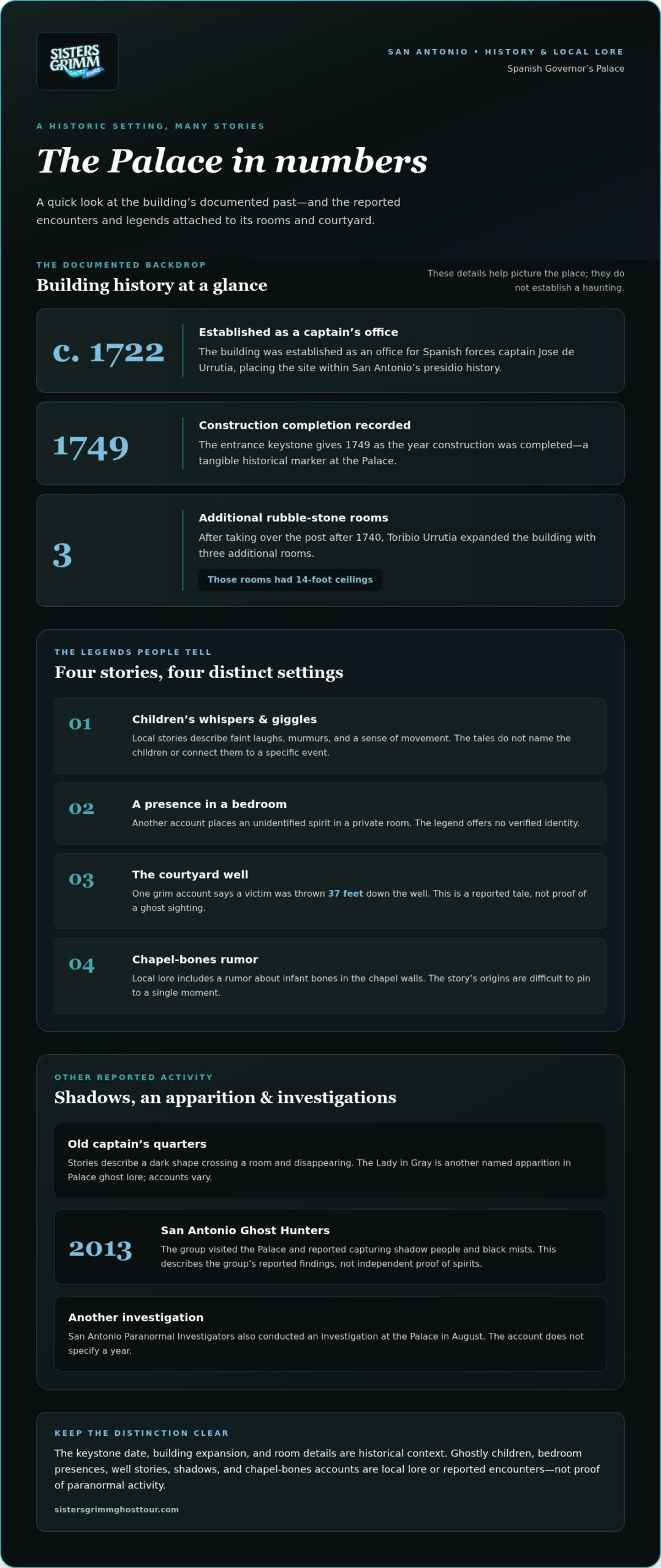
The Spanish Governor’s Palace ghost stories center on reported ghostly children, a spirit in a bedroom, the courtyard well, and bones associated with the chapel. The building’s entrance keystone gives 1749 as the year its construction was completed, adding a tangible piece of history to the eerie tales. These accounts are local lore and reported encounters, not proof of paranormal activity.
It’s easy to see why stories of shadowy rooms and a courtyard well stay with people. The Palace’s past sets the scene for its legends, while each tale offers a different explanation for why the historic site is said to be haunted.
Explore tales of children, a bedroom spirit, the well, and rumored bones in the chapel, alongside the history behind them. Together, they show why the Spanish Governor’s Palace remains one of San Antonio’s most intriguing settings for ghost stories.
Key Takeaways
- Separate the Palace’s documented history from the supernatural stories attached to its rooms and courtyard.
- Explore reports of ghostly children and a bedroom presence, and consider how the building’s past shapes these tales.
- Learn what local lore says about the courtyard well, including the reported 37-foot fall.
- Discover the chapel-bones rumor and why the stories’ origins are difficult to pin to a single moment.
- Choose a guided San Antonio ghost experience to hear more local history and legends brought to life.
Ghostly children and a spirit in the bedroom
Some of the Palace’s most intimate legends center on children’s whispers and giggles. The sounds are said to drift through rooms where visitors expect only silence and old stone. Rather than building on one dramatic event, the tale draws its unease from small details: a faint laugh, a murmur, or the sense that someone is nearby. The Spanish Governor’s Palace ghost stories invite readers to imagine a lively presence lingering in a historic home.
The stories don’t name the children or connect their appearances to a specific event. That uncertainty shapes the legend: a whispered voice suggests play, while a giggle makes an empty room feel suddenly occupied. Listeners may imagine children who once lived in or passed through the building, but those possibilities remain part of the tale, not established history. This distinction keeps the story intriguing without presenting an imagined explanation as fact.
Another account places a spirit in a bedroom. The mood shifts from sounds that might belong to playful children to a presence associated with a private room. That setting matters: a familiar domestic space can feel especially unsettling when a story places an unseen visitor inside it. The legend offers no verified identity for the spirit, so its appeal lies in the contrast between an ordinary room and the unexplained presence attributed to it.
The Palace’s physical history gives these stories a vivid backdrop. Its entrance keystone records 1749 as the year construction was completed. After taking over the post after 1740, Toribio Urrutia expanded the building with three additional rubble-stone rooms. The rooms he built had 14-foot ceilings. Those details don’t establish a haunting, but they help readers picture a structure shaped by successive occupants and changing uses.
The different settings help distinguish the children’s tales from the bedroom spirit legend. Whispers and giggles suggest movement and play; a spirit in a bedroom evokes a single, hushed encounter. Neither account needs a named ghost to create atmosphere. Each asks you to imagine how an old room might feel when its ordinary sounds seem to take on another meaning.
When sharing these accounts, keep the boundary between record and folklore clear. The 1749 keystone and Urrutia’s rooms belong to the Palace’s historical setting; the children’s voices and bedroom presence belong to reported supernatural lore. That contrast is part of their appeal. The building supplies the tangible details, while the stories leave space for imagination, a quiet laugh, and one last glance toward the doorway.
Reported deaths associated with the courtyard well
A grim courtyard tale gives the Palace’s well a central role. According to the account, a victim was thrown 37 feet down the well. The story turns an ordinary feature of the courtyard into a place of danger and lingering sorrow. It’s one of the Spanish Governor’s Palace’s most unsettling legends, though the tale’s supernatural force comes from its retelling, not from a documented ghost sighting at the bottom.
The courtyard isn’t the only setting linked to reported activity. Stories describe shadows in the old captain’s quarters, where a dark shape may seem to cross a room before vanishing. Shadow people are a familiar feature of paranormal storytelling, but the Palace’s tales place the image in rooms associated with its military past. The contrast between historic surroundings and a fleeting figure makes the account memorable.
Another apparition is known as the Lady in Gray. The name creates a vivid image, though details of individual encounters vary. Like the shadows, this figure belongs to paranormal lore, not the building’s documented history. Together, the accounts offer distinct sources of unease: a dangerous well, an unexplained shape, and a named apparition.
Ghost-hunting reports add another layer. San Antonio Ghost Hunters visited the Palace in 2013 and reported capturing shadow people and black mists. San Antonio Paranormal Investigators also conducted an investigation at the Palace in August. These accounts describe investigators’ reported findings, not independent proof of spirits. Their language matters: “reported capturing” preserves what the group said without presenting paranormal activity as established fact.
How does the Palace’s haunting compare with other San Antonio ghost stories? Its lore is tied to a specific historic building, its courtyard, and its old captain’s quarters. That gives these stories a more focused setting than legends that span an entire city.
The Spanish Governor’s Palace is in San Antonio, Texas. Its historical context includes the Alamo, which stood across the San Antonio River from the presidio site described in the Palace’s early history. Stories about the well, quarters, and apparitions keep the supernatural lore anchored to the Palace’s own rooms and courtyard.
Keep the accounts distinct as you explore them: the 37-foot well story describes a reported death, while the Lady in Gray and shadow figures belong to ghost lore. The 2013 investigation adds a named group and a reported finding, but it doesn’t change the difference between a historical account and a paranormal claim. That distinction lets you enjoy the Palace’s eerie atmosphere without mistaking every legend for a documented event.
Why is the Spanish Governor’s Palace haunted?
The Palace’s haunting reputation grows from a history of military rule, changing ownership, and preservation. Around 1722, the building was established as an office for Spanish forces captain Jose de Urrutia. That origin places the site within San Antonio’s presidio history, giving ghost stories a real historical setting. The past explains why the Palace attracts eerie tales, but it does not establish that spirits haunt its rooms.
Expansion followed after 1740, when Toribio Urrutia took over the post. The Palace developed beyond its early role as a captain’s office, becoming a building shaped by successive occupants and changing needs. For storytellers, that layered past offers atmosphere: the same rooms can be presented as traces of military life, domestic use, and later public history. The Spanish Governor’s Palace ghost stories draw much of their power from that overlap between a tangible place and an imagined presence.
Adina Emilia De Zavala helped bring attention to the building’s historic importance. Her newspaper article identifying it as an important historic structure was dated 1915. San Antonio purchased the Palace thirteen years after De Zavala wrote her column, in 1928. Those milestones tell a documented preservation story: public attention helped the old structure move toward protection rather than disappearance.
The Palace’s museum role added another chapter. Since 1931, it has functioned as a Museum of Spanish Colonial History. That purpose invites visitors to encounter the building through historical interpretation, not only through supernatural lore. A museum setting can make ghost stories feel more vivid because rooms and objects are presented within a human past. Still, the existence of historical exhibits does not verify a haunting.
Are there historical records or credible sources behind the Palace’s ghost stories? Historical records document the building’s origins, ownership, preservation, and museum history. Reported apparitions belong to folklore and paranormal accounts, not to the same category as documented dates and events.
Recognition also reflects the Palace’s historic value. San Antonio listed it as a Texas Historic Landmark in 1962, then it became a National Historic Landmark in 1970. Those designations speak to its importance as a historic site, not proof of supernatural activity. They help explain why stories connected to its rooms carry weight: the setting itself has a documented past worth preserving.
That distinction helps put claims in context. Jose de Urrutia, Toribio Urrutia, De Zavala, and the museum’s history connect the Palace to recorded events. Ghostly encounters add another layer, shaped by retellings and the building’s atmosphere. History provides the setting; legend adds mystery. Keeping those threads separate lets visitors appreciate the Palace’s real past and the stories associated with it.
Infant bones rumored to be in the chapel walls
One chilling Palace rumor claims infant bones are hidden in the chapel walls. The image is stark: a sacred room, concealed remains, and a building with a history spanning generations. But this should be described as a rumor, not an established discovery. The distinction matters: the Spanish Governor’s Palace has a documented history as a historic structure and museum, while the alleged bones belong to its supernatural lore.
The rumor draws its power from the contrast between a chapel and concealment. A chapel suggests worship, memory, and mourning; a wall suggests something sealed away. Together, those images invite questions about who the children might have been and why anyone would hide their remains. They create atmosphere, but they don’t establish identities, dates, or evidence.
The tale gives no names for the infants. That absence matters when retelling the rumor. Without supporting evidence, it would be misleading to connect the alleged bones to a particular family, tragedy, or historical event. Focus instead on what the legend actually claims: that remains are hidden within the Palace chapel, and that imagining them there can be unsettling.
San Antonio’s Spanish colonial past gives the story a compelling setting. The Palace’s history is tied to Spanish military administration and later preservation, while the chapel rumor adds a darker, more intimate note. These are different kinds of accounts: the building’s origins and museum role are historical, while the infant-bones story remains local lore. Keeping that distinction clear respects both the site and the people imagined in the tale.
Retellings can shift the emphasis of a rumor. One narrator may focus on the chapel’s solemn atmosphere; another may dwell on the walls and the possibility of concealed remains. Without a named child or specific event, each version can heighten the mystery differently. That flexibility helps the story endure, but it also makes careful wording important. Say “the rumor claims,” rather than presenting the bones as a confirmed discovery.
The Palace’s role as a museum of Spanish Colonial History gives visitors a useful frame. Historical interpretation explains the building’s past, while ghost lore shows how later stories attach meaning to its rooms. The two can coexist without being confused. A rumor about bones in the chapel may spark curiosity, but curiosity alone cannot turn a legend into a historical record.
Approach the tale as a haunting story, not a conclusion about actual remains. The Palace chapel provides the setting; the rumor supplies the unsettling possibility. Keeping them separate lets readers engage with the legend while recognizing what it says, and what it doesn’t establish, about the Spanish Governor’s Palace.
When did the Spanish Governor’s Palace ghost stories first appear?
The Palace’s ghost stories have no single, established starting date in its historical timeline. That timeline records the building’s military origins, later preservation, and museum role; legends can pass between storytellers without a dated first telling. A historic building can have a documented construction history even when its supernatural stories lack a clear beginning.
The site’s known history reaches back to its role as quarters for Spanish forces captain Jose de Urrutia, around 1722. Expansion began after 1740, and the entrance keystone gives 1749 as the year construction was completed. Those dates help set the scene for stories about old rooms and hidden corners, but they don’t date the first whisper, apparition, or retelling.
Later milestones describe preservation, not the birth of ghost lore. Adina Emilia De Zavala wrote about the building’s historic importance in 1915. San Antonio acquired the Palace in 1928, and it has functioned as a Museum of Spanish Colonial History since 1931. Each event made the building’s past more visible to the public; none marks a documented first appearance of its ghost stories.
That difference helps answer the question without confusing folklore with records. A date attached to a building, such as 1749, documents a historical milestone. A date attached to a ghost story would need to identify an early account or telling. The stories about the Palace’s children, bedroom spirit, well, and chapel belong to reported lore, and their familiar details can survive even as tellers change.
Paranormal investigations offer dated examples of later interest, not a starting point for the legends. San Antonio Ghost Hunters visited the Palace in 2013 and reported capturing shadow people and black mists. That visit gives one point on the timeline of modern ghost-hunting activity. It doesn’t establish when people first began telling stories about spirits at the site.
So read the Palace’s timeline in two tracks: historical events provide firm landmarks, while ghost stories reflect how people interpret a place with a long past. The construction era and preservation milestones explain why the setting draws attention; retellings keep its supernatural reputation alive. For a guided way to hear San Antonio’s haunted history and local legends, explore a haunted history ghost walk.
Sisters Grimm Ghost Tours: Ghost Bus Tour In San Antonio
Sisters Grimm Ghost Tours offers guided San Antonio experiences that bring local history and legends to life. If the Palace’s stories spark your curiosity, the Ghost Bus Tour In San Antonio explores the city through spooky storytelling and cultural context. Prefer to explore on foot? The Haunted History Ghost Walk offers a guided outdoor walk, while the Haunted Pub Crawl: The Ghost Bus pairs haunted tales with a pub crawl for guests aged twenty-one and older. For a more tailored outing, book The Unique Private Tour.
These tours suit visitors who want more than a list of ghost stories: they connect eerie accounts with San Antonio’s historic atmosphere. Choose the format that fits your interests, then visit Sisters Grimm Ghost Tours to explore the experiences.
Carry San Antonio’s Stories Into Your Next Adventure
The Spanish Governor’s Palace ghost stories can be a starting point, not the final stop. Let curiosity guide what you notice next: the character of historic places, the way local legends change through retelling, and the questions a vivid story leaves behind. Distinguishing folklore from documented history makes room for both wonder and thoughtful exploration.
For your next outing, choose the storytelling experience that suits your mood. A guided ghost tour can add local legends and historical context to an evening in San Antonio, making familiar streets feel new. Sisters Grimm Ghost Tours offers a bus tour, a history walk, and a haunted pub crawl. Book your preferred tour online.
Ready to explore more of the city’s eerie tales? Contact Sisters Grimm Ghost Tours and find a spirited way to continue your San Antonio adventure.
Frequently Asked Questions
What is the Spanish Governor’s Palace in San Antonio, Texas?
The Palace is a preserved Spanish colonial building in San Antonio, associated with the presidio and its military administration. Today, visitors can explore it as a museum focused on Spanish Colonial History. That setting helps explain why stories about former occupants and unexplained presences gather around its rooms. The Palace is a historic site first; its ghostly reputation comes from legends and reported experiences connected with the building.
What ghost stories or paranormal legends are associated with the Spanish Governor’s Palace?
Local lore includes tales of children’s voices, a bedroom spirit, a reported death connected with the courtyard well, and infant bones rumored to be hidden in the chapel walls. The stories describe different things: sounds, apparitions, a tragic account, or concealed remains. Treat each as a separate legend rather than combining them into one documented event or assuming they share an origin.
What are the reported ghost sightings and unexplained experiences at the palace?
Reported experiences include whispers and giggles attributed to children, shadow figures, black mists, and an apparition called the Lady in Gray. San Antonio Ghost Hunters reported capturing shadow people and black mists during a 2013 visit. These descriptions record what witnesses or investigators said they experienced. They can make compelling ghost lore, but a reported sighting is different from independently established evidence of paranormal activity.
Is the Spanish Governor’s Palace considered haunted by paranormal investigators?
Some investigators have reported paranormal activity at the Palace, but that doesn’t establish a shared conclusion among investigators. San Antonio Ghost Hunters reported shadow figures and black mists after visiting in 2013, and San Antonio Paranormal Investigators conducted an investigation there in August. These are reports associated with particular visits, not proof that the building is haunted or that every visitor will experience something unexplained.
Can visitors take ghost tours or paranormal tours at the Spanish Governor’s Palace?
Explore San Antonio ghost stories with Sisters Grimm Ghost Tours’ Ghost Bus Tour In San Antonio or Haunted History Ghost Walk. Both combine local legends with historical storytelling; neither is presented as a paranormal investigation at the Palace. The Ghost Walk is an outdoor walking tour, while the Ghost Bus Tour explores the city by bus. Book online through Sisters Grimm Ghost Tours.
Where is the Spanish Governor’s Palace, and what nearby San Antonio attractions are associated with ghost stories?
The Spanish Governor’s Palace is in San Antonio, Texas. The Alamo stood across the San Antonio River from the presidio site described in the Palace’s early history.