
What if the bone-chilling wail echoing along the San Antonio River isn’t just a campfire story, but a centuries-old warning from a civilization long lost to time? You’ve likely seen the Hollywood movies or heard the whispered warnings to stay away from the water’s edge after dark. It’s easy to feel overwhelmed by the conflicting versions of the la llorona legend, especially when every storyteller adds their own ghostly flair. We’re pulling back the velvet curtain to reveal the true history of the Weeping Woman. We’ll move beyond the silver screen to uncover the real spirits haunting our local creeks and rivers.
This guide explores how ancient Aztec omens and the Spanish Conquest shaped this tragic figure into the icon we recognize today. You’ll visit the specific San Antonio locations, from the far east side to the heart of downtown, where she’s still spotted by the brave and the curious. By the end, you’ll know exactly how to separate historical fact from folklore and understand why her cry still resonates through the Texas night. Welcome to the mystery; we’ve been expecting you.
Key Takeaways
- Uncover the ancient roots of the la llorona legend as we trace her origins back to Aztec goddesses and the eerie omens of the Spanish Conquest.
- Identify the specific San Antonio waterways and landmarks where local residents still report hearing the Weeping Woman’s tragic wail.
- Separate Hollywood fiction from historical folklore by debunking common myths about her motives and the true meaning behind her appearance.
- Learn how to distinguish between different “lady in white” spirits to understand which one truly haunts the older bends of the San Antonio River.
- Discover how you can bridge the gap between myth and reality by visiting the city’s most spirited sites with a local expert storyteller.
Who is the Weeping Woman? Defining the La Llorona Legend
Imagine a moonlit night by the San Antonio River where the air is thick with humidity and the scent of damp earth. Suddenly, a sound cuts through the silence. It isn’t the wind or a distant coyote. It’s a high-pitched, mournful cry that seems to vibrate in your very bones. This is the calling card of La Llorona, also known as the Weeping Woman or The Wailer. She is a spirit eternally trapped between worlds, mourning the children she lost by her own hand. While many know her as a spooky character from a movie, the la llorona legend is a deeply rooted piece of folklore that has haunted the Americas for centuries.
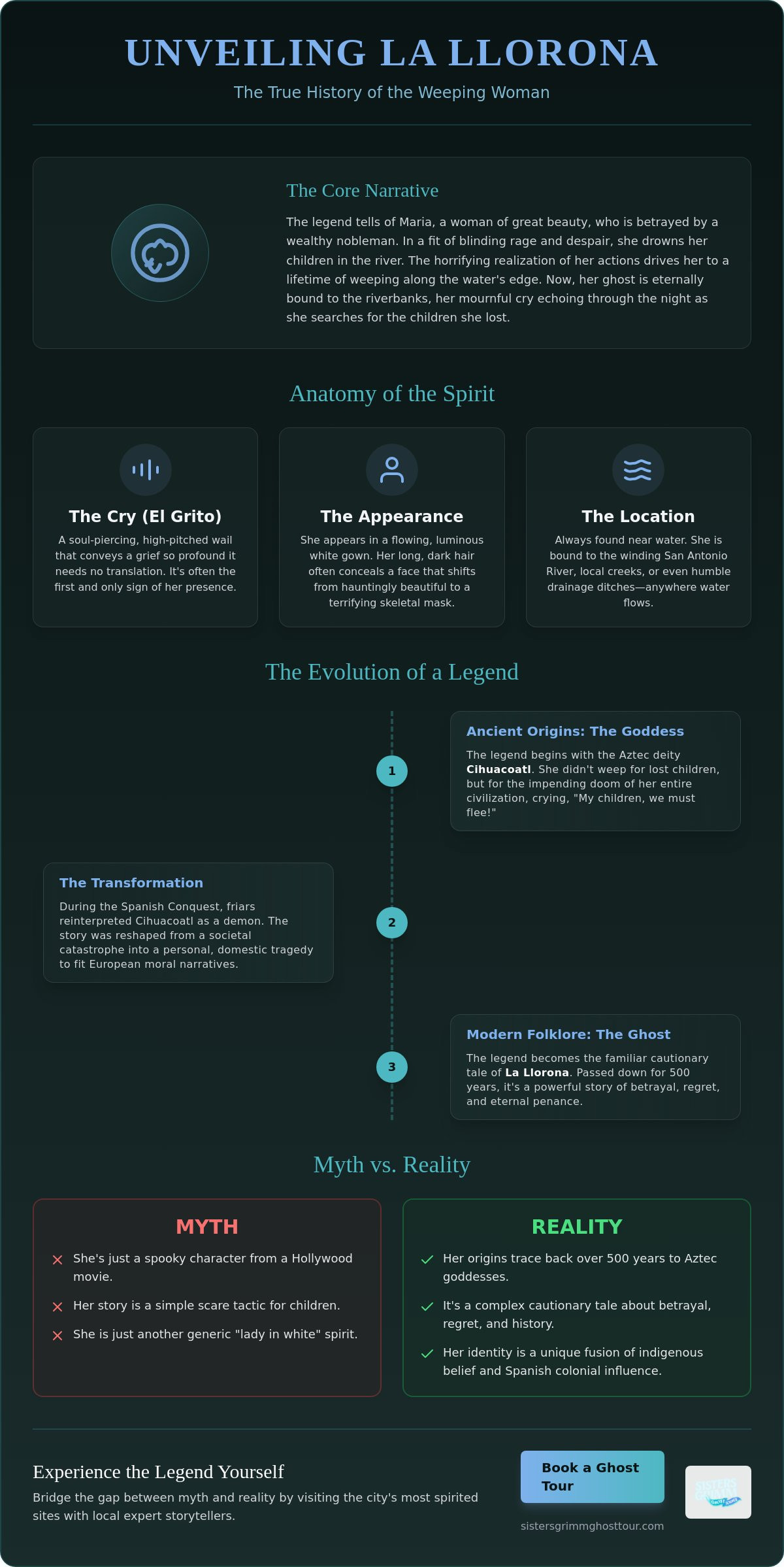
The core narrative usually follows a woman named Maria. She was a woman of staggering beauty but lived in a world of limited means. Her beauty eventually caught the eye of a wealthy nobleman, but their romance was destined for disaster. When he eventually turned his back on her, Maria was consumed by a blinding fit of rage and despair. In a moment of madness, she threw her children into the river. The realization of what she’d done struck her instantly, but the water had already claimed them. She spent the rest of her life wandering the banks, weeping, until she eventually withered away. Now, her ghost is bound to the water’s edge, searching for any child to replace the ones she lost.
The Universal Story of the Wailer
For over 500 years, this tale has been passed down through oral tradition, evolving with every retelling but keeping its dark heart intact. It serves as a powerful cautionary tale in Hispanic households. “Don’t go near the water after dark,” parents warn, “or La Llorona will take you.” Beyond being a simple scare tactic, the story resonates because it taps into viscerally real human emotions. It’s about the sting of betrayal, the weight of regret, and the terrifying concept of eternal penance. This emotional core is why the la llorona legend has survived through generations of storytellers.
The Visual and Auditory Hallmarks
Her grito, or cry, is a soul-piercing sound that transcends language barriers, conveying a grief so profound it needs no translation. Witnesses often describe her wearing a shimmering, flowing white gown that glows in the moonlight. Some see this as a symbol of the purity she lost, while others believe it’s the burial shroud she was laid to rest in. Her long dark hair often masks her face, which can shift in an instant from hauntingly beautiful to a terrifying, skeletal mask. She is always found near water. Whether it’s the winding San Antonio River or a humble drainage ditch, she remains a permanent fixture of the night.
Ancient Omens and Aztec Origins: The Real History
Before she was a woman in a white dress wandering the San Antonio River Walk, she was a goddess. The La Llorona in Texas that we recognize today is actually a centuries-old fusion of indigenous belief and Spanish influence. To truly understand her, we have to look back to the high temples of the Aztec Empire. Long before the first brick was laid in San Antonio, the people of central Mexico spoke of Cihuacoatl. She was a powerful deity, often depicted with a skeletal jaw, who walked the streets of Tenochtitlán at night. She didn’t hunt for replacement children; she wept for the impending doom of her entire civilization.
Cihuacoatl: The Mother of Ghost Stories
Cihuacoatl was originally a figure of protection, the patron of women who died in childbirth. However, as the Spanish Conquest loomed, her character shifted from a guardian to a harbinger of catastrophe. When Spanish friars arrived, they didn’t see a goddess; they saw a demon. They interpreted these indigenous spirits through the lens of their own European ghost stories. This cultural collision began the transformation of the la llorona legend. The tragedy was no longer about the fall of a great empire, but about a personal, domestic tragedy that anyone could understand. It was a clever way for the new rulers to reshape local lore into something that fit their own moral narratives.
The Omens of 1519
The year 1519 was a time of terror and mystery. According to the accounts recorded by Bernardino de Sahagún, the “Sixth Omen” of the conquest was a woman heard crying through the night. She would shout, “My children, we must flee far from this city!” This wasn’t just a spooky tale. It was a historical record of a people sensing their end. The Florentine Codex stands as the first written record of a wailing spirit in the Americas, documenting a figure that would eventually migrate north to our own waterways. If you want to feel this history for yourself, you might consider a Haunted History Ghost Walk to see where these ancient echoes still linger.
We also cannot ignore the “Malinche” connection. Malintzin, or Doña Marina, was the indigenous woman who served as an interpreter for Hernán Cortés. Many historians believe she is a primary blueprint for the Weeping Woman. She was a woman caught between two worlds, often viewed as a traitor to her people. Her story is one of betrayal and deep emotional weight, much like the Maria we discussed earlier. When Spanish Catholicism merged with these indigenous spirits, it created a hauntingly perfect archetype. A spirit that is both a mother and a monster, a victim and a villain, forever bound to the water where empires and families alike were lost.
Myth vs. Reality: Busting Common Misconceptions
The silver screen has a habit of turning complex spirits into one-dimensional monsters. If you’ve only seen the recent blockbusters, you might think the la llorona legend is just another vengeful ghost story. It isn’t. In reality, the Weeping Woman is far more nuanced than a simple jump scare. One of the biggest myths is that hearing her cry is an immediate death sentence. While it’s certainly not a sound you want to hear at 3:00 AM, traditional lore suggests her wail is often a warning of coming misfortune rather than a guarantee of your demise. She is a harbinger, not always the executioner.
Another common misconception is that she is a demonic entity. In the eyes of those who grew up with her stories, she is more accurately described as an anima sola, or a soul in purgatory. She isn’t looking for blood; she’s looking for redemption. This makes her a figure of pity as much as one of fear. She is bound to the water not out of a desire to hunt, but because she is trapped in a cycle of eternal penance, searching for what can never be recovered.
The “Evil Ghost” Trope
Hollywood has flattened this cultural icon into a slasher villain. They focus on the vengeful aspect, but the sorrowful side is what has kept the story alive for centuries. In many versions told across San Antonio, Maria is portrayed as a victim of a cruel, unfaithful husband. Her actions are a result of a psychological break, not inherent evil. This distinction matters. It transforms her from a monster into a tragic figure whose pain is so great it echoes through time. Understanding her as a victim of circumstance adds a layer of gravity that a movie screen just can’t capture.
Geographic Myths
Don’t make the mistake of thinking she only haunts the rivers of Mexico. The la llorona legend is a cornerstone of Tejano culture right here in Texas. In San Antonio, her sightings often spike during times of local tragedy. For instance, many old-timers connected her cries to the devastating San Antonio flood of September 1921, which claimed over 50 lives. She becomes the voice of the river when it turns deadly, a personification of the city’s relationship with its waterways.
Interestingly, she has also become a symbol of resistance. In Chicana feminism, La Llorona is often reclaimed as a figure who refuses to be silent about her suffering. She isn’t just a ghost; she’s a cultural mirror reflecting the struggles of women throughout history. If you want to see where these myths meet reality, our Ghost Bus Tour In San Antonio takes you to the very places where these stories feel most tangible.
La Llorona in San Antonio: Local Sightings and Landmarks
San Antonio is a city built on water and stone. Our limestone-heavy geography does more than just provide a foundation for our historic buildings; it acts as a natural acoustic chamber. The winding waterways of the San Antonio River and the various creeks that spiderweb through the city create the perfect environment for echoes to travel. For centuries, locals have claimed these echoes carry more than just the sound of the wind. The la llorona legend isn’t a distant story here. It’s a localized phenomenon that feels as real as the humidity in the air. When the sun dips below the horizon, the city’s relationship with its rivers takes on a much more mysterious tone.
Woman Hollering Creek: A Local Mystery
If you drive east on I-10 toward Seguin, you’ll cross a bridge over a small body of water with a curious name: Woman Hollering Creek. There is a fierce linguistic debate among local historians about how this name came to be. Some argue it’s a clunky mistranslation of the la llorona legend. Others believe it marks the site of a different pioneer tragedy involving a woman protecting her family from an attack. Regardless of the origin, the sightings are consistent. Travelers along this stretch of highway have reported seeing a figure in white standing by the guardrail. Paranormal investigators often treat the creek as a pilgrimage site, hoping to catch a recording of the scream that gave the water its name.
The River Walk Echoes
Downtown San Antonio has its own share of watery spirits. Before the Great Flood of 1921 led to the creation of the modern River Walk, the river was wild and prone to devastating overflows. These older, darker bends of the water are where the “lady in white” is most frequently seen. Many sightings occur near the Alamo and the haunted history of the Emily Morgan Hotel. This area is a dense pocket of historical energy. Have you ever heard a sound like a distant wind on a perfectly calm night near the river? Many believe that isn’t the wind at all, but the residual energy of a mother still searching for what she lost in the currents.
The proximity of these sightings to our most sacred historical sites suggests that the Weeping Woman is woven into the very fabric of San Antonio. She isn’t just passing through. She is a permanent resident of our haunted landscape. If you’re ready to see these landmarks for yourself and hear the stories the history books won’t tell you, join us on a Haunted History Ghost Walk. We’ll walk the same banks where the whispers are strongest and explore the secrets hidden beneath the city’s surface.
Experience the Legend: Why the Sisters Grimm Bring History to Life
Reading about the la llorona legend in the safety of your home is one thing, but feeling the temperature drop as you stand near the water’s edge is quite another. We believe that history shouldn’t stay trapped in dusty textbooks or flickering screens. It’s a living, breathing thing that deserves to be told with a bit of flair and a lot of heart. That’s where we come in. We’ve spent years digging through local archives and listening to the accounts of those who live along our city’s waterways. This ensures that every story we share is grounded in truth, even when that truth is stranger than fiction. Our goal is to act as your friendly guide between the mundane world and San Antonio’s storied past.
Our Ghost Bus Tour in San Antonio is designed to take you beyond the typical tourist traps. We visit the hidden corners of the city where the veil between the past and the present feels thinnest. It’s on these darkened streets, away from the neon lights, that the la llorona legend stops being a myth and starts feeling like a shared memory. We invite you to step into the narrative and see the city through the eyes of those who have walked its banks for centuries.
Beyond the Campfire Story
Storytelling is the heartbeat of our culture. It’s how we preserve the educational side of ghost lore without losing the excitement that makes it memorable. There’s a specific kind of thrill that comes from standing in the exact spot where a legend was born. Our guides are master storytellers who blend historical facts with the spirited energy of a live performance. We don’t just give you dates and names; we give you the atmosphere of the era. This “theatrical reverence” ensures that these cultural stories are never forgotten, keeping the spirits of San Antonio alive for every new generation of explorers.
Join the Sisterhood of Storytellers
Your journey into the unknown begins at our physical headquarters, located at 204 Alamo Plaza. This isn’t just a meeting spot; it’s a hub for discovery. Inside, you’ll find our retail shop filled with Sisters Grimm Books, authored by our founders, Lauren and James Swartz. These books dive even deeper into the local lore we’ve discussed today, offering a permanent piece of the mystery to take home. For those who want to explore the full breadth of San Antonio’s supernatural history through the written word, our collection of haunted history books in San Antonio provides the names, dates, and site-specific details that serious enthusiasts crave. If you’re looking for a more intimate look at the city’s secrets, you can also book a Unique Private Tour for your group. San Antonio is waiting to tell you its secrets. Don’t just read about the wail; experience the history that created it.
Step Into the Story and Face the Shadows
We’ve traced the echoes of the Weeping Woman from the high temples of the Aztec Empire to the winding, limestone banks of our own San Antonio River. You now know that the la llorona legend is far more than a simple campfire scare. It’s a profound cultural tapestry woven with threads of ancient omens, colonial tragedy, and local history. Whether she’s a harbinger of misfortune or a soul seeking redemption, her presence is a permanent part of our city’s haunted landscape. She isn’t just a ghost; she’s a reminder of the secrets that water and stone can hold.
Since 2011, we’ve been the city’s premier guides to these hidden histories. As local experts rated #1 for San Antonio ghost experiences, we pride ourselves on professional storytelling that respects the gravity of the past while embracing the thrill of the unknown. Don’t let the mystery remain a story on a screen. Book your San Antonio Ghost Tour and hear the legends for yourself! The river is calling. We’ll see you in the shadows.
Frequently Asked Questions
Is La Llorona a real person?
She isn’t a single historical figure with a verifiable birth certificate. Instead, she is a cultural archetype that has evolved over five centuries. Her story likely began as a personification of the Aztec goddess Cihuacoatl before merging with tales of real women like Malintzin. She represents a collective history of grief and betrayal rather than one specific individual from the past.
Where is Woman Hollering Creek in San Antonio?
This creek is located on the city’s far east side, crossing under Interstate 10 between San Antonio and Seguin. It’s easily identified by the official bridge signs that mark the waterway. Local residents and travelers often stop there to experience the eerie atmosphere of the banks. It remains one of the most accessible landmarks for those hunting for a piece of authentic local lore.
What is the difference between La Llorona and the Lady in White?
The primary difference lies in the specific motivation and the sound of the spirit. La Llorona is defined by her mournful grito and the tragic drowning of her children. A Lady in White is a broader category of ghost found in many cultures. In San Antonio, a Lady in White might be a jilted bride at a hotel, whereas the Weeping Woman is always tied to the water.
Can La Llorona actually hurt you?
In most traditional versions of the story, she is a harbinger of bad luck rather than a physical attacker. Her wail serves as a warning to stay away from dangerous currents or to return home before dark. However, darker variations of the folklore suggest she might try to lure children into the water. It’s best to treat her as a sign to be cautious and respectful of the past.
What is the true story of why she drowned her children?
The true story varies by region, but the emotional core is always betrayal. Most accounts tell of a beautiful woman named Maria who was abandoned by a wealthy nobleman. In a moment of blinding rage or deep psychological distress, she turned her sorrow toward her children. This act of desperation led to her eternal penance. It’s a story that explores the darkest corners of the human heart.
Are there any movies about La Llorona that are historically accurate?
Most films about the la llorona legend prioritize theatrical horror over historical facts. While they capture the visual of the woman in white, they often miss the deeper Aztec roots and the complexity of her character as a soul in purgatory. For a truly accurate understanding, it’s better to consult local historians or read books authored by those who study San Antonio’s specific folklore. Our guide to the best haunted history books San Antonio has to offer is an excellent place to start your research.
How do you protect yourself from La Llorona according to legend?
Folk traditions offer several ways to ward off her spirit. Some suggest carrying a small piece of iron or steel, as many believe spirits are repelled by cold metal. Others recommend wearing an item of clothing inside out to confuse the ghost. The most practical advice from local elders is simple. Don’t wander the riverbanks alone at night when the mist begins to rise from the water.
Beyond these traditional folk remedies, those who seek deeper spiritual guidance or help with paranormal disturbances often consult practitioners like Mama Vilikazi & Papa Sungu Best spell casters worldwide, who specialize in navigating complex spiritual and personal challenges.
Why is San Antonio considered a hotspot for La Llorona sightings?
San Antonio’s unique blend of limestone geography and a high density of natural springs creates an ideal setting for these stories. The city’s deep-seated Tejano roots ensure the la llorona legend is passed down through every generation. Our history is filled with river-based tragedies, such as the 1921 flood, which provide a real-world foundation for the supernatural claims. It’s a city where the past is never truly buried. If you’re looking for a unique way to share this haunted history with someone special, a ghost tour gift card san antonio makes for an unforgettable present that opens the door to the city’s darkest secrets.